

Ubuntu 24.04+ Has a Hidden Feature That Cleans Up Your Desktop
A messy desktop is one of the most common productivity problems in modern computing.
It rarely starts as a problem.
You download a PDF and leave it on the desktop for later. Then you take a few screenshots. A ZIP archive arrives. You save an image from a browser, copy a document from an external drive, and temporarily place a project file where you can access it quickly.
A few days later, your desktop contains dozens of files.
A few weeks later, it becomes difficult to find anything.
Most users know the traditional solution: create folders and manually move files into them. But that requires discipline, time, and a willingness to interrupt your workflow every time a new file appears.
Ubuntu has a lesser-known feature that offers a simpler alternative.
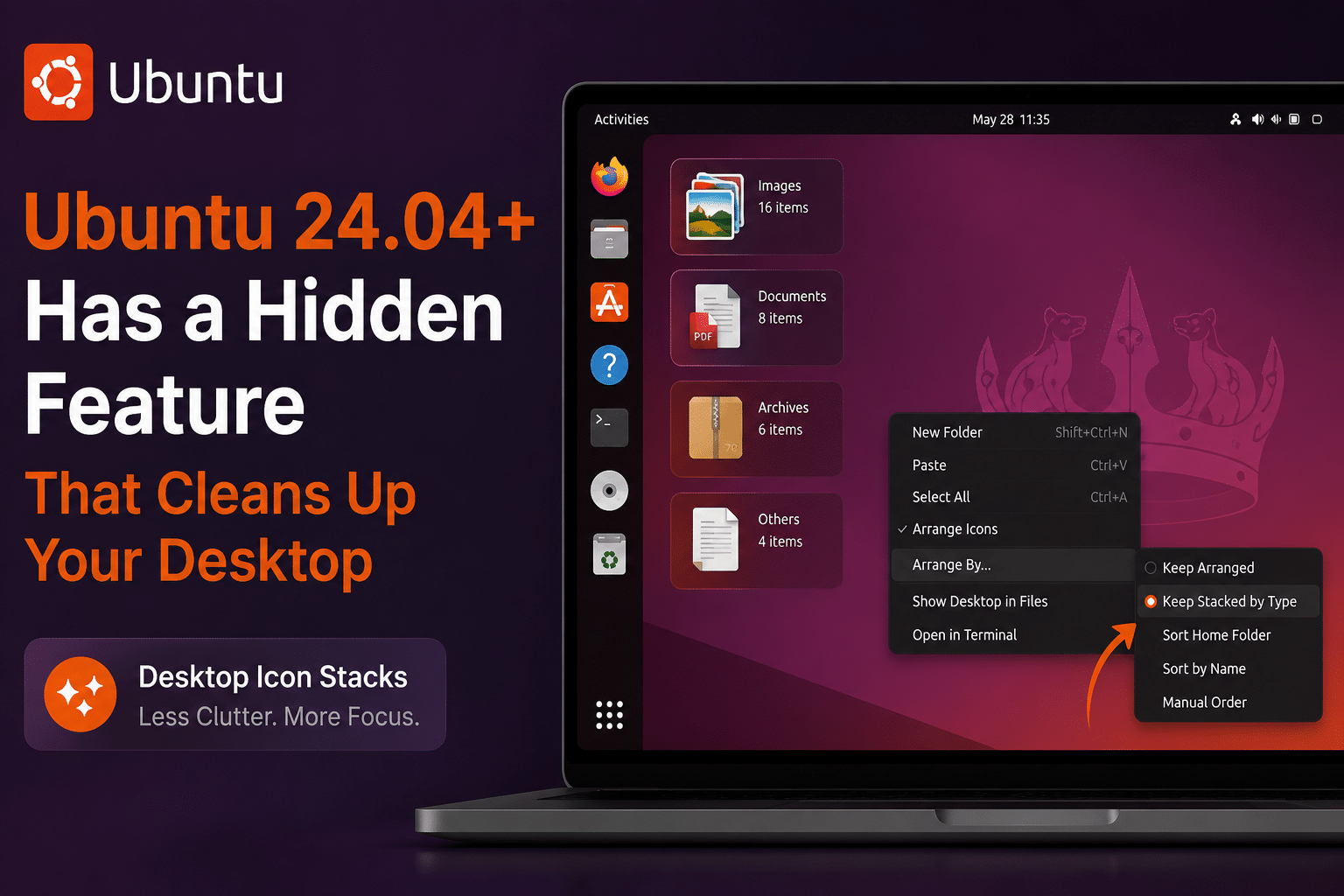
If you’re using Ubuntu 24.04 LTS or a newer release, the Desktop Icons NG (DING) extension includes a desktop stacking feature that can automatically group files of similar types into collapsible stacks.
Images can group together.
PDFs can group together.
Documents can group together.
Instead of dozens of individual icons spreading across your desktop, Ubuntu can visually consolidate similar files into organized groups.
The best part is that the feature doesn’t physically move your files.
It simply changes how they are displayed.
A recent report highlighted this useful but relatively unknown capability in Ubuntu’s Desktop Icons NG extension, showing that users can enable file stacking directly from the desktop without installing additional software.
This may sound like a small usability improvement, but it reflects something much bigger about modern computing.
Productivity isn’t always about buying faster hardware or installing more software.
Sometimes productivity comes from removing friction.
A cleaner desktop reduces visual noise. Better organization makes files easier to find. And when users extend their work beyond a local computer, properly structured Linux infrastructure can provide the same kind of clarity at a larger scale.
That’s where solutions such as a HOMERDP Linux VPS become relevant. While Ubuntu desktop stacks help organize your local workspace, a dedicated Linux VPS can help developers and businesses separate workloads, create isolated environments, and keep projects from overwhelming a single personal computer.
Let’s explore Ubuntu’s hidden desktop stacks feature, how it works, why digital clutter matters, and what this small feature can teach us about building more productive Linux workflows.
The Problem With Desktop Clutter
The desktop was originally designed as a convenient workspace.
It gives users quick access to files, folders, applications, and shortcuts.
But convenience can quickly become chaos.
Think about the types of files that often end up on a typical desktop:
- Screenshots
- Images
- PDF documents
- ZIP archives
- Word processing files
- Spreadsheet exports
- Shell scripts
- Configuration files
- Project backups
- Temporary downloads
- Installation packages
- Notes
- Presentation files
Each file might have a legitimate reason for being there.
The problem is accumulation.
Digital clutter behaves much like physical clutter. One item doesn’t create a problem. Ten items may still be manageable. But once dozens or hundreds of unrelated objects occupy the same workspace, finding what you need becomes slower.
The desktop loses its purpose as a quick-access area.
Instead, it becomes an unstructured storage location.
This creates several practical problems.
Important files become harder to find
Users often scan visually for a file rather than using search.
When dozens of icons appear simultaneously, that process takes longer.
Temporary files become permanent
A file placed on the desktop “for now” often remains there for months.
Similar files become scattered
A user might have screenshots mixed between PDFs, archives, documents, and images.
Visual distractions increase
Every icon competes for attention.
Even if users don’t consciously think about the clutter, the workspace becomes harder to scan.
Traditional folders solve many of these problems, but they require manual intervention.
Ubuntu’s stacking feature offers another approach.
Instead of asking users to immediately reorganize files, it organizes the visual presentation of those files.
That difference is important.
What Are Desktop Stacks in Ubuntu?
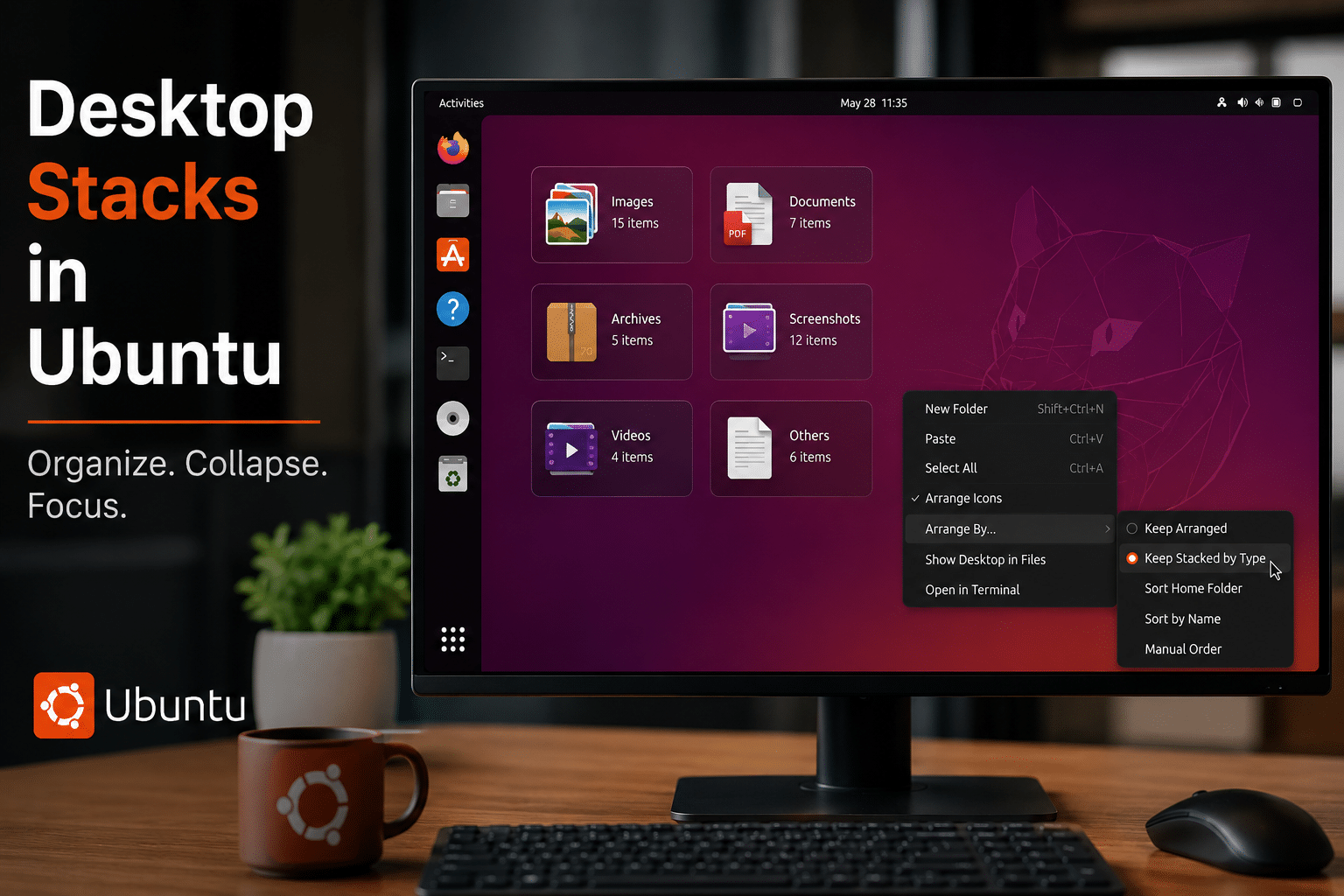
Ubuntu’s desktop stacking functionality is part of Desktop Icons NG, commonly called DING.
DING is the extension Ubuntu uses to provide desktop icons and related functionality.
The stacking feature groups files of the same type into a single collapsible stack.
For example, imagine your desktop contains:
- 15 PNG screenshots
- 8 JPG images
- 6 PDF files
- 4 ZIP archives
- 3 text documents
Without stacks, all of these files appear individually.
With stacks enabled, Ubuntu can visually group matching file types, significantly reducing the number of icons competing for space.
You can then click a stack to expand it and access the files inside.
The files themselves remain on your desktop.
Nothing is moved into a new folder.
Nothing is archived.
Nothing is deleted.
The stack is a visual organization tool rather than a traditional file-management system.
How to Enable Desktop Stacks in Ubuntu
One of the best things about this feature is how easy it is to activate.
You don’t need to install an application.
You don’t need to open a terminal.
You don’t need to configure complicated settings.
On supported Ubuntu versions, you can enable stacks directly from the desktop.
Step 1: Right-click an empty area of the desktop
Open the desktop context menu.
Step 2: Select “Arrange by”
Ubuntu provides options for organizing desktop items.
Step 3: Choose “Keep stacked by type”
Once enabled, compatible files begin grouping into stacks according to their file type.
That’s it.
If you later decide that you prefer the traditional desktop layout, simply return to the same menu and disable the option.
The feature is available through Ubuntu’s preinstalled Desktop Icons NG extension, meaning users don’t need to download an additional desktop customization tool to use it.
Why This Feature Is More Useful Than It Looks
At first glance, desktop stacks may seem like nothing more than a cosmetic improvement.
But good interface design often works by eliminating small repetitive frustrations.
Think about how many times you interact with your desktop.
You might:
- Save a screenshot
- Download a document
- Extract an archive
- Copy a file
- Drag an attachment
- Create a temporary note
These actions happen constantly.
The individual inconvenience is small.
But repeated friction accumulates.
A productivity feature doesn’t need to transform your entire operating system to be valuable.
It simply needs to make a recurring task easier.
Desktop stacks do exactly that.
Instead of requiring immediate manual organization, they provide automatic visual grouping.
This creates a useful middle ground between two extremes:
Extreme One: Complete Desktop Chaos
Everything remains visible individually.
Extreme Two: Strict Manual Organization
Every file must immediately be moved into the correct folder.
Stacks offer a third option.
Users can continue working naturally while Ubuntu reduces visual clutter in the background.
Visual Organization Without Changing File Locations
One of the smartest aspects of the feature is that it doesn’t interfere with the underlying file structure.
Suppose you have twenty screenshots on your desktop.
A traditional organization tool might move them into a folder.
That could be useful, but it also changes where the files are located.
Stacks work differently.
The screenshots remain where they were.
Ubuntu simply presents them as a group.
This separation between physical organization and visual organization is valuable.
Users often need temporary files to remain easily accessible.
For example:
- A designer may need multiple images during an active project.
- A developer may need screenshots while debugging.
- A writer may need several PDFs for research.
- A system administrator may need logs and configuration backups temporarily available.
Moving everything into folders too early can interrupt the workflow.
Stacks allow users to keep files accessible while reducing clutter.
Desktop Stacks vs Traditional Folders
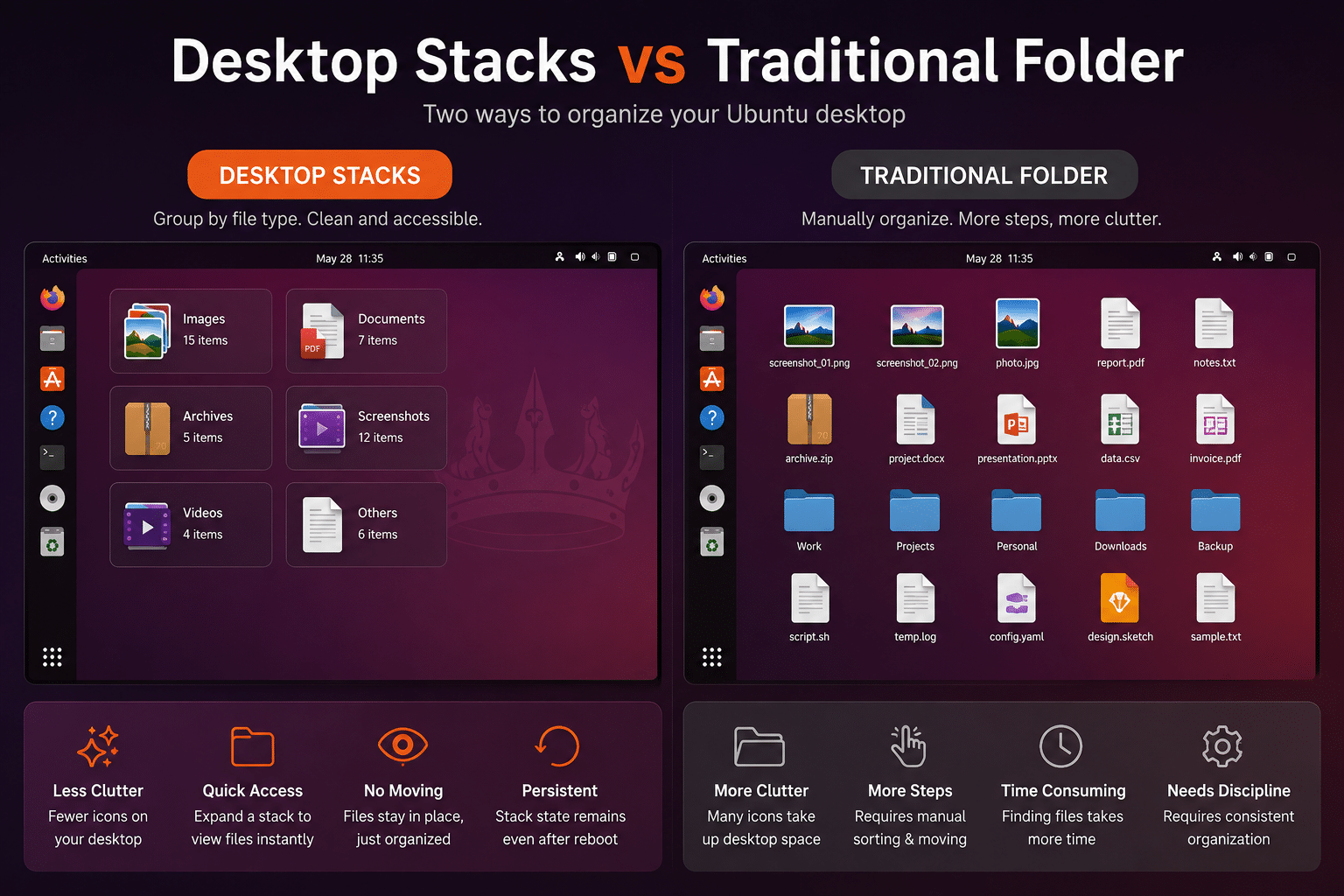
Stacks are useful, but they are not designed to replace folders.
The two tools solve different problems.
| Traditional Folders | Desktop Stacks |
|---|---|
| Organize files permanently | Organize files visually |
| Create a hierarchical structure | Create type-based groups |
| Require moving files | Keep files in their existing location |
| Best for long-term storage | Best for active workspaces |
| Depend on manual organization | Reduce clutter automatically |
| Can contain different file types | Primarily group similar file types |
The best workflow combines both.
For example:
- Work with files on the desktop temporarily.
- Allow stacks to reduce visual clutter.
- Complete the active task.
- Move important files into permanent project folders.
This approach recognizes an important reality.
People don’t always organize files immediately.
And they shouldn’t necessarily have to.
Technology should support natural workflows rather than forcing users to constantly stop what they are doing.
A Useful Feature for Developers
Developers often generate an extraordinary number of temporary files.
During a single project, a developer may create or download:
- Error screenshots
- Application logs
- Database exports
- Configuration backups
- Test files
- Compressed source archives
- Documentation PDFs
- Shell scripts
- Debugging output
- Image assets
These files frequently appear on the desktop because the developer needs quick access to them.
Imagine debugging a web application.
You might take ten screenshots showing different UI states.
You download several log files.
You export a database backup.
You receive a PDF specification.
Suddenly, the desktop becomes crowded.
Desktop stacks can help group similar files while keeping them immediately accessible.
Screenshot Stack
All screenshots can appear together rather than spreading across the screen.
Document Stack
PDF files can visually group together.
Archive Stack
Downloaded ZIP and compressed files can remain organized.
Temporary File Management
Users can continue working without constantly stopping to create folders.
For developers, this matters because context switching has a cost.
Every unnecessary organizational task interrupts concentration.
Automation and interface improvements help preserve focus.
Ubuntu Is Quietly Improving Everyday Usability
Ubuntu often receives attention for major developments.
New releases generate discussions around:
- GNOME updates
- Linux kernels
- Snap packages
- Security changes
- Desktop design
- Hardware support
But smaller improvements can have an equally meaningful impact.
The Desktop Icons NG extension has continued evolving, including a GTK4 port and improvements related to usability and keyboard accessibility.
Recent development made desktop stacks more accessible through keyboard interaction while also modernizing the extension’s technology stack.
This is an important sign of desktop maturity.
A mature operating system doesn’t only chase dramatic new features.
It improves the details.
A faster right-click menu.
Better keyboard navigation.
More consistent design.
Improved file handling.
These refinements might not make headlines outside the Linux community, but users experience them every day.
Ubuntu’s desktop stacks are a good example.
The feature isn’t revolutionary.
It’s practical.
And practical features often provide the greatest long-term value.
Why File Organization Matters in Modern Computing
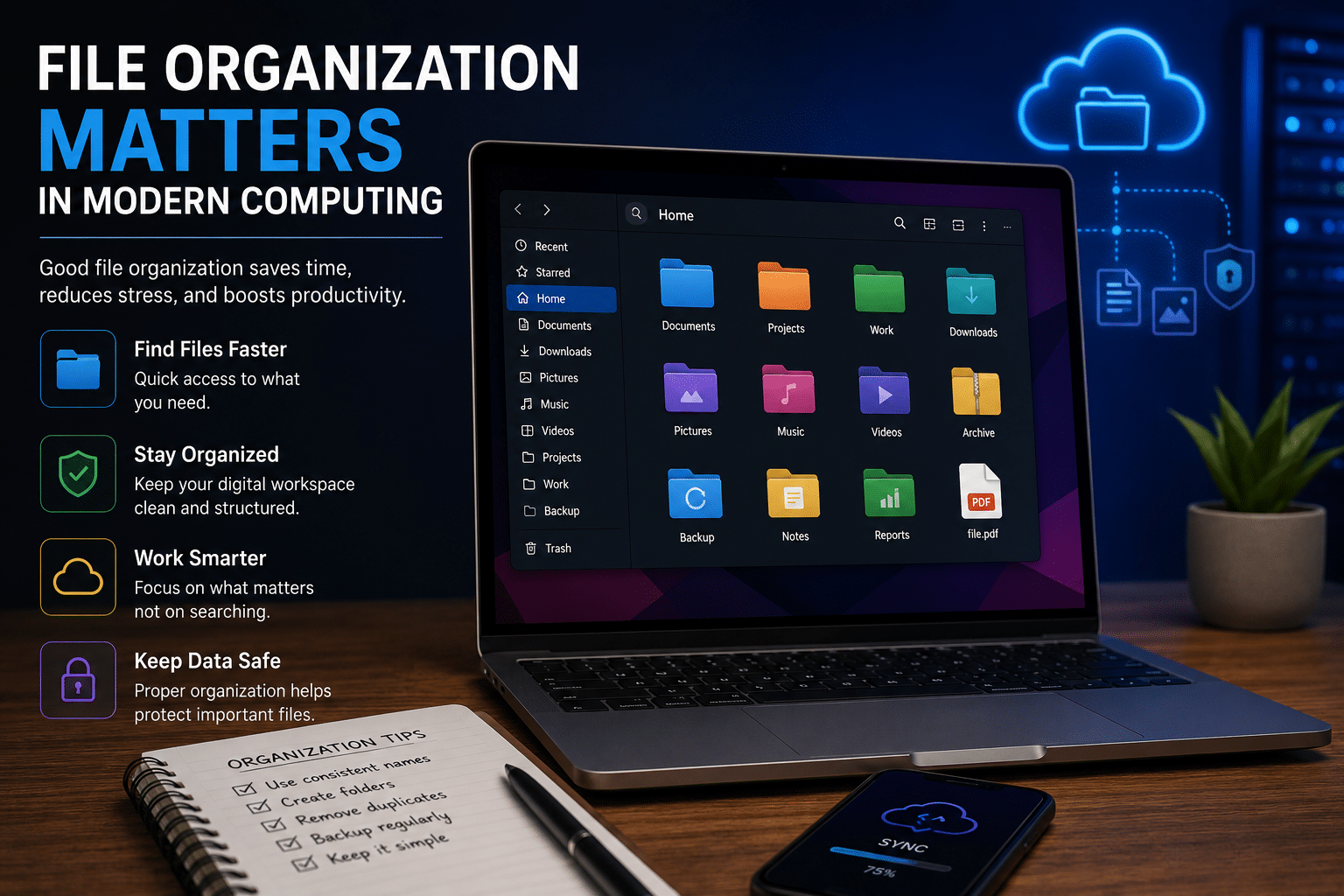
The amount of digital information people manage continues to grow.
A modern professional may work with files from:
- Email attachments
- Cloud storage
- Messaging applications
- Web downloads
- Collaboration platforms
- Development tools
- Cameras and smartphones
The desktop frequently becomes the first destination for many of these files.
This creates a workflow challenge.
The faster people work, the less likely they are to organize everything immediately.
That doesn’t mean users are disorganized.
It means their workflow prioritizes the current task.
Desktop stacks acknowledge this behavior.
Instead of demanding perfect organization, the feature helps manage imperfect organization.
That is an important principle in technology design.
The best tools adapt to real user behavior.
They don’t assume users will follow an idealized workflow every time.
From Desktop Organization to Infrastructure Organization
There is an interesting connection between organizing files and organizing computing environments.
Both are fundamentally about reducing unnecessary complexity.
A cluttered desktop creates confusion because unrelated files occupy the same workspace.
A cluttered infrastructure environment creates confusion because unrelated workloads occupy the same server.
Consider a developer running everything locally.
Their computer might simultaneously contain:
- Personal files
- Development projects
- Docker containers
- Databases
- Test environments
- Local web servers
- Experimental applications
- Production credentials
This approach can work for small projects.
But as workloads grow, separation becomes valuable.
A structured workflow might divide responsibilities.
Local Ubuntu Desktop
Used for:
- Daily work
- Writing code
- Browsing
- Documentation
- Communication
Development Server
Used for:
- Testing applications
- Running containers
- Experimenting with configurations
Staging Environment
Used for:
- Pre-production testing
- Deployment validation
Production Infrastructure
Used for:
- Live applications
- Persistent services
- Customer-facing workloads
This is essentially the infrastructure equivalent of cleaning your desktop.
Instead of putting everything in one place, you separate workloads according to purpose.
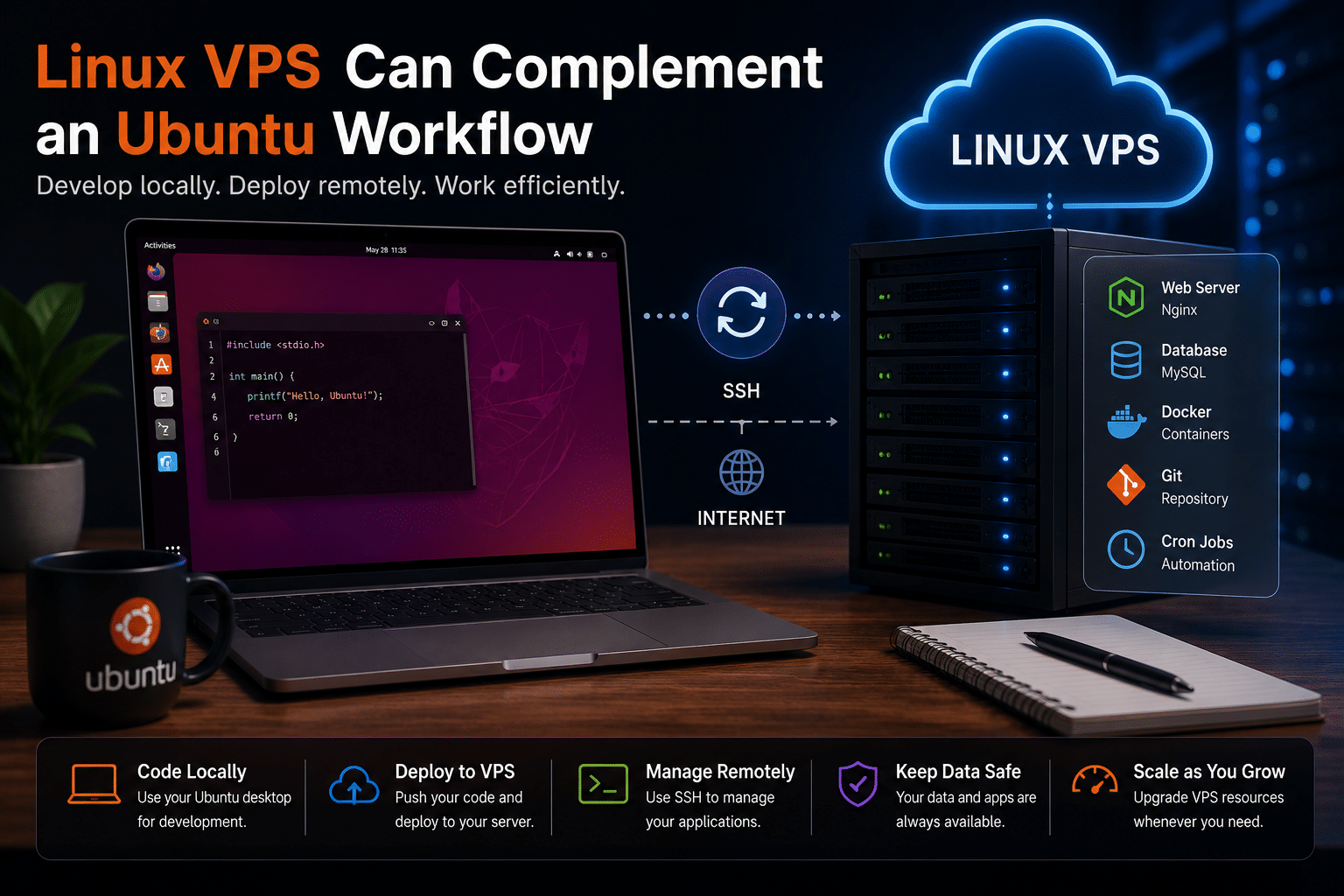
Why a Linux VPS Can Complement an Ubuntu Workflow
As developers and businesses grow, relying entirely on a local computer can become limiting.
A laptop is excellent for active development.
But persistent workloads often need an environment that remains available independently of the user’s personal device.
This is where a Linux VPS becomes useful.
A Virtual Private Server provides an isolated computing environment that users can configure for specific workloads.
For example, a developer might use an Ubuntu desktop for coding while using a remote Linux VPS for:
- Hosting applications
- Running development environments
- Testing deployments
- Managing web servers
- Running automation tasks
- Hosting databases
- Maintaining persistent services
This separation can create a cleaner workflow.
Your personal machine remains your workspace.
Your server becomes dedicated infrastructure.
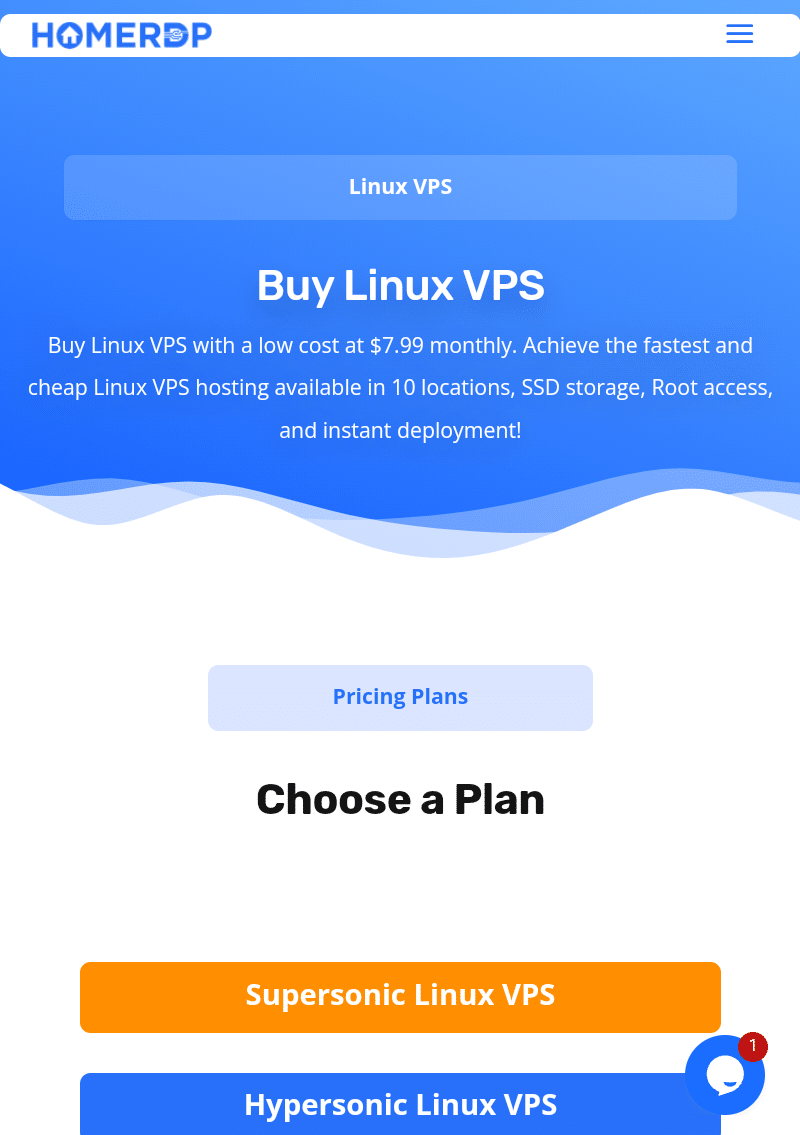
HOMERDP offers Linux VPS plans with configurations ranging from smaller development-oriented instances to higher-resource options. Its service highlights dedicated VPS resources, root access, NVMe/SSD storage, bandwidth allocations, and multiple deployment locations.
The connection to desktop organization may seem indirect, but the underlying principle is the same:
Separate what needs to be separated. Keep important resources accessible. Reduce unnecessary clutter.
How HOMERDP Fits Into Modern Linux Workflows
A Linux VPS from HOMERDP can be relevant for users who want to expand beyond a single local Linux installation.
Here are several practical scenarios.
1. Developers Can Separate Local and Remote Workloads
Developers don’t need every service running on their laptop.
A remote Linux VPS can provide an environment for:
- Application testing
- Backend development
- Docker deployments
- Web servers
- APIs
- Automation tools
This can reduce pressure on local hardware and create a clearer separation between personal and project workloads.
2. Freelancers Can Access a Consistent Environment
Freelancers may work from multiple computers.
Maintaining identical development environments on every device can be inconvenient.
A remote Linux environment provides consistency.
The user can connect to the same server environment regardless of which local machine they are currently using.
3. Startups Can Build Isolated Infrastructure
Growing teams often need an environment for testing and deployment before they require complex enterprise infrastructure.
A VPS can provide a starting point for:
- Company websites
- Internal applications
- Development servers
- Testing environments
- Automation services
4. Linux Learners Can Practice Server Administration
Learning Linux isn’t limited to the desktop.
Users who become comfortable with Ubuntu can eventually explore:
- SSH
- Server configuration
- Web hosting
- Firewall management
- Docker
- Databases
- Automation
A dedicated virtual environment provides a separate place to experiment without modifying a primary personal system.
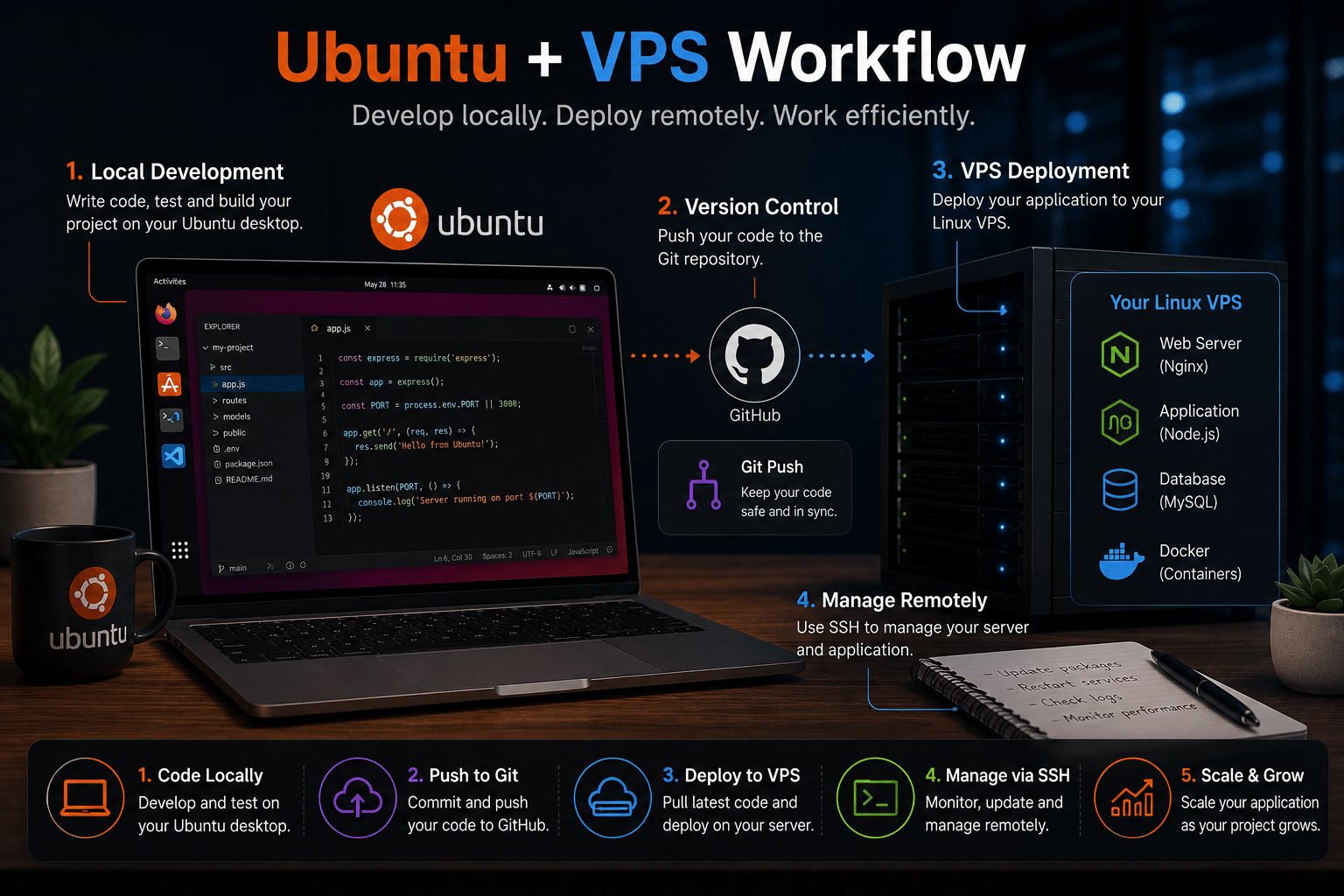
A Practical Ubuntu + VPS Workflow
Consider a web developer building an application.
A structured workflow could look like this.
Stage One: Local Development
The developer works on Ubuntu.
Their desktop contains:
- Code editors
- Browsers
- Terminal windows
- Documentation
- Screenshots
During development, temporary files accumulate.
Ubuntu’s desktop stacks help reduce visual clutter.
Stage Two: Version Control
The developer pushes code to a Git repository.
The local machine remains the active workspace.
Stage Three: Remote Deployment
The application moves to a Linux VPS.
The remote environment handles:
- Web server configuration
- Application processes
- Databases
- Background services
Stage Four: Separation of Responsibilities
The local machine handles productivity.
The server handles persistent workloads.
This workflow is easier to manage than treating one computer as the solution to every problem.
And that principle scales.
A clean system architecture often begins with simple separation.
The Hidden Cost of Context Switching
One reason desktop stacks are valuable is that they reduce small interruptions.
Imagine this scenario.
You are working on an important task.
You save another screenshot.
Now you can’t find the previous screenshot.
You stop.
You scan the desktop.
You rearrange several icons.
You open a folder.
You move files.
You return to your original task.
None of these actions are particularly difficult.
But they interrupt concentration.
The same thing happens in infrastructure.
When environments are poorly organized, developers spend time asking:
- Where is this application running?
- Which configuration belongs to which project?
- Is this the testing database or production database?
- Which server contains the current version?
Organization reduces these questions.
Good structure preserves mental energy.
Desktop stacks reduce friction at the interface level.
Dedicated environments reduce friction at the infrastructure level.
Small Improvements Can Create Better Long-Term Habits
One interesting aspect of Ubuntu’s stacking feature is that it doesn’t force a new workflow.
It works with the existing desktop.
That makes adoption easy.
Users don’t need training.
They simply enable the feature.
The same principle applies to successful productivity tools.
The best tools often have a low barrier to entry.
Consider the difference between:
A complicated organizational system requiring hours of configuration
and
A simple feature that immediately reduces clutter
Most users will choose the second option.
Ubuntu’s stacks succeed because they are simple.
Right-click.
Arrange.
Enable stacking.
Done.
There is no complicated setup process.
Best Practices for Keeping Your Ubuntu Desktop Organized
Desktop stacks work even better when combined with sensible file management habits.
Here are several practical strategies.
1. Treat the Desktop as an Active Workspace
The desktop should contain files you are actively using.
It shouldn’t become permanent storage.
Once a project is complete, move important files elsewhere.
2. Enable Stacks for Temporary Organization
If you regularly work with screenshots, downloads, or documents, stacks can immediately reduce visual clutter.
Enable:
Right-click → Arrange by → Keep stacked by type
3. Create Clear Project Directories
For long-term work, use a structure such as:
Projects/
├── Client-Work/
│   ├── Project-A/
│   └── Project-B/
├── Personal/
├── Open-Source/
└── Experiments/
4. Keep Temporary Files Separate
Consider creating a dedicated temporary directory for files you don’t plan to keep permanently.
This makes cleanup easier.
5. Use Search Instead of Visual Scanning
Ubuntu provides powerful file-search capabilities.
When a file disappears into a crowded directory, searching can be faster than manually browsing.
6. Separate Critical Workloads
Don’t run every service and application on the same environment if separation makes management easier.
Use dedicated servers, containers, or virtual machines where appropriate.
7. Back Up Important Data
Organization is not a replacement for backup.
A perfectly organized desktop can still be lost because of hardware failure.
Keep important files backed up independently.
What Desktop Stacks Don’t Do
It’s also important to understand the limitations.
Stacks are not a complete file-management solution.
They do not:
- Automatically create permanent folders
- Organize files by project
- Replace backups
- Understand the importance of files
- Provide advanced tagging
- Create complex hierarchical structures
They organize primarily by file type.
That means two unrelated images may appear together simply because they share the same general type.
This is why stacks work best as a visual cleanup tool rather than a complete organizational strategy.
The feature’s simplicity is also its limitation.
But for its intended purpose, simplicity is a strength.
Ubuntu’s Focus on Everyday Refinement
Ubuntu has spent years balancing two important goals.
First, it needs to remain powerful enough for:
- Developers
- System administrators
- Engineers
- Businesses
- Researchers
Second, it needs to remain accessible for everyday users.
Small desktop improvements help bridge that gap.
Recent DING development has also brought improvements to keyboard interaction, modernized components through GTK4, and refined parts of the desktop icon experience.
These changes may seem minor individually.
Together, they improve how the operating system feels.
That matters.
Users judge software not only by its biggest features but also by the quality of thousands of small interactions.
Why Modern Linux Productivity Is About More Than Software
The traditional view of productivity focuses on applications.
You install:
- A better text editor
- A faster browser
- A more powerful IDE
- A new terminal
Those tools matter.
But productivity also depends on environment design.
Ask yourself:
- Is your desktop easy to navigate?
- Can you find important files quickly?
- Are your projects separated?
- Are your development environments isolated?
- Can you reproduce your workflow on another machine?
These questions become increasingly important as workloads grow.
A developer with excellent software but poor organization can still waste significant time.
A well-designed workflow reduces friction.
That workflow can start with something as simple as cleaning up desktop icons.
From a Clean Desktop to a Clean Computing Strategy
There is a broader lesson behind Ubuntu’s hidden stacks feature.
Organization is scalable.
At the smallest level, you organize files.
At the next level, you organize folders.
Then projects.
Then development environments.
Then servers.
Then infrastructure.
The same basic principle continues:
Give every resource a clear purpose.
Desktop stacks group similar items.
Project folders group related work.
Containers group application dependencies.
Virtual servers separate computing workloads.
The technologies change.
The organizational philosophy remains similar.
This is why the connection between Ubuntu desktop productivity and remote Linux infrastructure makes sense.
Users who value an organized workspace often eventually value organized infrastructure.
A local Ubuntu system provides a productive foundation.
A dedicated Linux environment can provide the next layer when projects require persistent or isolated resources.
HOMERDP’s Linux VPS offerings provide one option for users who need dedicated virtual resources, administrative control, and the flexibility to configure Linux environments around specific workloads.
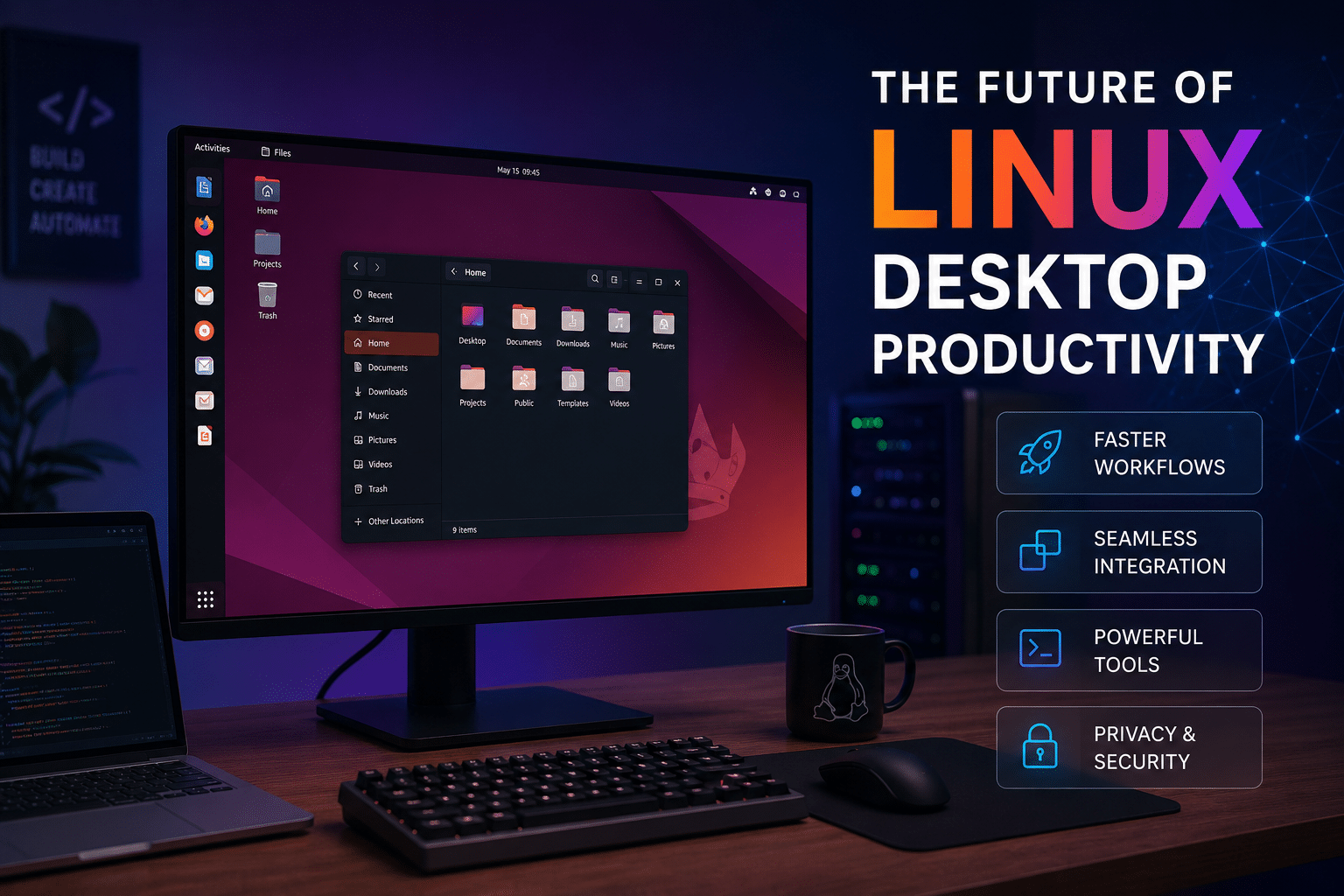
The Future of Linux Desktop Productivity
Linux desktops have changed significantly over the years.
The platform has moved from being perceived primarily as a technical operating system into a flexible environment capable of supporting:
- Everyday computing
- Creative work
- Software development
- Cloud engineering
- Business applications
- Education
- Research
Ubuntu has played an important role in making Linux more approachable.
Features such as desktop stacks demonstrate that progress doesn’t always require radical redesign.
Sometimes the most useful improvements are the ones users barely notice until they start using them.
You enable stacks.
Your desktop becomes cleaner.
You spend less time searching.
The feature quietly improves your workflow.
That is good software design.
Final Thoughts
Ubuntu 24.04 and newer releases include a useful feature that many users may never discover: desktop file stacks.
With a simple setting, users can group similar files into collapsible stacks and reduce the visual clutter that naturally accumulates during daily work.
The feature doesn’t move files.
It doesn’t force users into a complicated organizational system.
It simply makes an existing workspace easier to manage.
And that’s what makes it valuable.
The lesson extends beyond desktop icons.
Modern productivity depends on reducing friction at every level.
Organize files.
Separate projects.
Keep temporary work manageable.
Use dedicated environments when workloads grow.
For Ubuntu users, desktop stacks offer a quick and practical way to make the local workspace cleaner. For developers, freelancers, startups, and Linux professionals who need to move beyond a single machine, services like a HOMERDP Linux VPS can provide dedicated remote infrastructure for isolated workloads and persistent Linux environments.
The connection between these two ideas is simple.
A clean desktop helps you focus.
A clean infrastructure strategy helps you scale.
And productivity often begins not with adding more tools, but with making better use of the tools you already have.
So if your Ubuntu desktop currently looks like a digital dumping ground filled with screenshots, PDFs, downloads, and forgotten files, try the hidden stacking feature.
Right-click your desktop.
Choose Arrange by.
Enable Keep stacked by type.
Sometimes the smallest changes make the biggest difference in how a workspace feels.
And in a world where digital clutter continues to grow, a little organization can go a very long way.
EXPLORE MORE ; Windows to Linux Without Rebooting
READ OUR BLOGS