


How Nitrux 6.1 Is Redefining Linux Workstations for AI, DevOps, and Remote Engineering
Linux desktops are no longer niche environments reserved for hobbyists and system administrators. Over the last few years, Linux has transformed into a serious workstation platform for AI engineers, DevOps teams, cybersecurity professionals, software developers, cloud architects, and distributed enterprises.
Nitrux 6.1 represents one of the clearest examples of that transformation.
Built around Linux Kernel 7.0, optimized with performance-focused patches, designed for Wayland-first workflows, and engineered with immutable concepts in mind, Nitrux 6.1 is not trying to imitate traditional Linux desktops. It is building a modern computing platform for high-performance engineering workloads.
At the same time, the rise of remote-first organizations has fundamentally changed how enterprises deploy Linux infrastructure. Teams now require secure, scalable, GPU-capable remote workstations that deliver local-like performance from anywhere.
That combination creates a major opportunity for remote infrastructure providers like HOMERDP.
Nitrux 6.1 delivers the modern Linux workstation. HOMERDP helps organizations operationalize it securely and efficiently at scale.
The Linux Desktop Has Entered a New Era
For years, enterprise Linux adoption focused heavily on servers, containers, virtualization, and cloud infrastructure. Desktop Linux remained fragmented and often lagged behind Windows and macOS in polish, graphics acceleration, and usability.
That reality is changing rapidly.
Several major shifts are driving Linux workstation adoption:
- AI development growth
- GPU-intensive workloads
- Remote engineering teams
- DevOps automation
- Wayland maturation
- Immutable operating systems
- Cloud-native development workflows
- Cybersecurity demands
Modern developers no longer want bloated operating systems that consume unnecessary resources or restrict customization. They want:
- Speed
- Stability
- Security
- Flexibility
- Efficient resource management
- Modern graphics handling
- Low-latency workflows
Nitrux 6.1 directly targets those priorities.
What Exactly Is Nitrux 6.1?
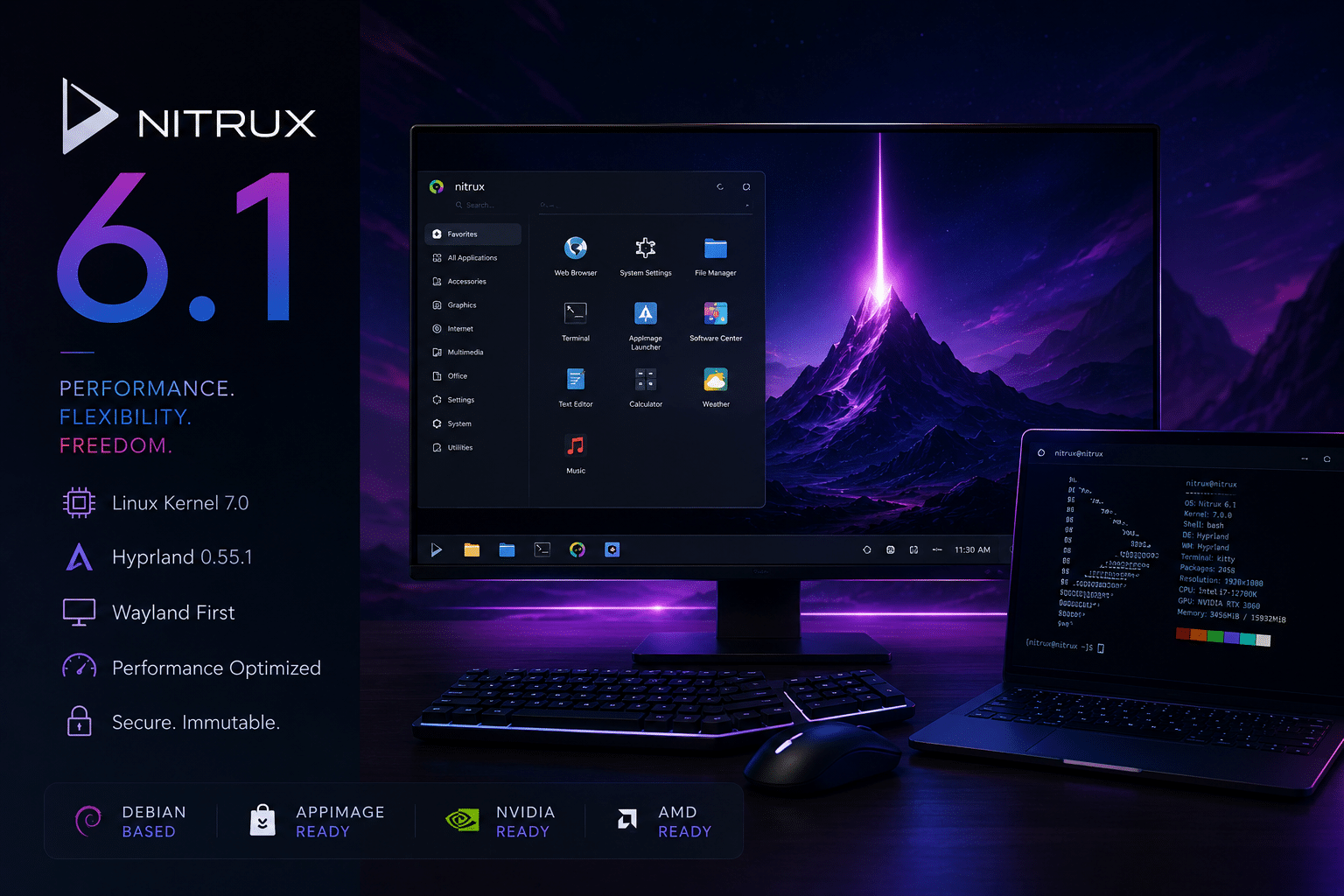
Nitrux is a Debian-based Linux distribution focused on portability, modern UI design, performance optimization, and advanced desktop technologies.
Unlike conventional Linux distributions that prioritize maximum backward compatibility, Nitrux aggressively embraces newer technologies such as:
- Wayland
- Hyprland
- Immutable concepts
- AppImage ecosystems
- Performance-tuned kernels
- Advanced graphics workflows
Nitrux 6.1 significantly expands that vision.
The release introduces:
- Linux Kernel 7.0.8
- Hyprland 0.55.1
- Updated KDE Frameworks
- Better NVIDIA compatibility
- CachyOS performance optimizations
- Enhanced Wayland support
- Improved gaming and graphics responsiveness
- Better system stability
This release is strategically important because it aligns Linux desktops with the realities of modern engineering workloads.
Why Linux Kernel 7.0 Matters for Workstations
Kernel upgrades are not merely technical version bumps.
For modern workstations, the kernel directly impacts:
- CPU scheduling
- Memory efficiency
- Disk I/O
- GPU communication
- Networking performance
- Power management
- Latency handling
Linux Kernel 7.0 introduces improvements that matter particularly for:
- AI model training
- Kubernetes environments
- Local LLM inference
- Docker-heavy workloads
- GPU acceleration
- Multi-threaded development
- Virtualization
Nitrux enhances this further with CachyOS-inspired tuning designed to maximize responsiveness and throughput.
That means developers can experience:
- Faster compile times
- Better desktop responsiveness under heavy loads
- Reduced stuttering during GPU tasks
- Improved multitasking
- Lower latency during intensive workflows
For AI engineers running local inference pipelines or containerized ML environments, these optimizations become especially valuable.
AI Development Is Changing Linux Requirements
Artificial intelligence workloads are forcing operating systems to evolve faster than ever.
A few years ago, most development machines primarily handled:
- IDEs
- Browsers
- Basic virtualization
- Lightweight scripting
Today, AI-focused workstations regularly manage:
- Multi-gigabyte datasets
- GPU acceleration
- Tensor operations
- Local model inference
- Container orchestration
- CUDA pipelines
- Distributed development stacks
This dramatically increases workstation requirements.
Developers need:
- Efficient GPU scheduling
- Strong memory management
- High filesystem performance
- Stable drivers
- Modern display servers
- Better thermal and power optimization
Traditional Linux desktop environments often struggle under these demands because many still carry legacy architecture designed for older workflows.
Nitrux 6.1 approaches the problem differently.
Its Wayland-first architecture and performance-centric kernel tuning help reduce bottlenecks that commonly affect modern AI workflows.
Wayland and Hyprland Are More Important Than Most People Realize
One of the most significant aspects of Nitrux 6.1 is its investment in Wayland and Hyprland.
Many organizations still underestimate how important this shift is.
X11 served Linux well for decades, but it was designed for a very different computing era. Modern workloads now require:
- Better GPU utilization
- Smoother rendering
- Lower latency
- Stronger security isolation
- Multi-monitor optimization
- Better scaling support
Wayland addresses many of these limitations.
Hyprland adds another layer by offering:
- Dynamic tiling
- Smooth animations
- Efficient workflow management
- Better resource utilization
- Highly customizable layouts
For developers managing:
- Multiple terminals
- Monitoring dashboards
- Kubernetes clusters
- Documentation
- Browser debugging
- SSH sessions
- Cloud consoles
Hyprland can significantly improve productivity.
Instead of relying on overlapping window chaos, users gain structured workspace management with reduced friction.
That matters more than aesthetics.
In engineering environments, workflow efficiency directly affects productivity.
Remote Engineering Is Now the Default
The global shift toward distributed work fundamentally changed infrastructure requirements.
Organizations now routinely manage:
- Remote developers
- Offshore engineering teams
- Hybrid IT operations
- Cloud-native workflows
- Distributed DevOps pipelines
As a result, the workstation itself is evolving.
Instead of every employee relying on powerful local hardware, many organizations now centralize compute resources while providing remote access to Linux environments.
This creates several advantages:
- Better security control
- Easier device management
- Lower hardware costs
- Faster onboarding
- Centralized updates
- Improved compliance
However, it also introduces challenges.
Modern Linux desktops with GPU acceleration and Wayland workflows require significantly more advanced remote desktop infrastructure than legacy remote tools can provide.
That is where HOMERDP becomes highly relevant.
Why Traditional Remote Desktop Solutions Struggle
Many older remote access systems were designed for:
- Office productivity
- Static desktop interfaces
- Minimal graphics workloads
- Low-resolution displays
Modern Linux engineering environments are very different.
Today’s workloads involve:
- GPU acceleration
- High-refresh-rate displays
- Multiple monitors
- Real-time rendering
- AI model visualization
- Heavy browser-based tooling
- Container dashboards
- Complex graphical workflows
Traditional remote desktop tools frequently introduce:
- Latency spikes
- Poor rendering quality
- Inconsistent scaling
- GPU incompatibilities
- Performance bottlenecks
- Session instability
Wayland environments can further expose these limitations because older protocols were built around X11 assumptions.
Organizations deploying advanced Linux workstations therefore need remote infrastructure specifically capable of handling modern graphical workloads.
How HOMERDP Complements Modern Linux Workstations
HOMERDP helps enterprises modernize Linux workstation access for remote engineering environments.
Instead of relying on outdated remote access stacks, organizations can centralize high-performance Linux systems while enabling secure access for distributed teams.
This becomes particularly valuable for:
- AI engineering teams
- DevOps departments
- Cloud infrastructure teams
- Cybersecurity analysts
- Remote software developers
- GPU-intensive workflows
Key benefits include:
1. Centralized Infrastructure Management
Organizations can deploy powerful Linux workstations in centralized environments rather than maintaining expensive hardware for every employee.
This simplifies:
- Maintenance
- Security patching
- Hardware upgrades
- Compliance management
2. Better Security Posture
Centralized Linux environments reduce endpoint risk.
Sensitive workloads remain inside managed infrastructure instead of spreading across unmanaged devices.
This is especially important for:
- Enterprise source code
- Proprietary AI models
- Infrastructure credentials
- Customer datasets
3. Improved Resource Utilization
GPU-enabled servers can serve multiple engineering teams more efficiently than isolated individual machines.
This reduces:
- Hardware waste
- Idle compute capacity
- Infrastructure fragmentation
4. Faster Team Scaling
Remote infrastructure allows organizations to onboard developers quickly without shipping expensive hardware globally.
Teams can provision Linux environments in hours instead of weeks.
5. Better Business Continuity
Centralized workstation infrastructure improves resilience.
If a user device fails, engineers can reconnect instantly from another endpoint without losing their workstation environment.
Immutable Linux Is Becoming an Enterprise Strategy
Nitrux’s immutable-inspired direction deserves special attention.
Immutable operating systems are rapidly gaining traction because they solve several long-standing enterprise problems.
Traditional systems often suffer from:
- Configuration drift
- Dependency conflicts
- Manual customization inconsistencies
- Unstable updates
Immutable environments improve predictability by reducing uncontrolled system modification.
Benefits include:
- Better reliability
- Easier rollback
- Stronger security
- Consistent deployments
- Reduced troubleshooting
For DevOps teams, this aligns naturally with:
- Infrastructure as code
- GitOps workflows
- Kubernetes principles
- Declarative system management
Nitrux’s direction reflects a broader industry movement toward reproducible infrastructure.
When combined with centralized remote workstation deployment through HOMERDP, enterprises gain:
- Easier environment replication
- Standardized developer workstations
- Lower operational overhead
- Better compliance management
DevOps Teams Need Faster Workstations
Modern DevOps engineers routinely handle:
- Kubernetes clusters
- Terraform automation
- CI/CD pipelines
- Infrastructure monitoring
- Container management
- Cloud orchestration
- Security scanning
These workflows can overwhelm older workstation environments.
Nitrux 6.1’s optimized kernel and lightweight architecture help reduce unnecessary overhead.
This creates several productivity advantages:
- Faster terminal responsiveness
- Better container performance
- Reduced desktop lag
- Improved multitasking
- Smoother virtualization handling
When teams access these environments remotely through optimized infrastructure, they gain flexibility without sacrificing performance.
GPU Acceleration Is No Longer Optional
One major trend shaping Linux workstation evolution is universal GPU dependence.
GPU acceleration now affects:
- AI development
- Video rendering
- Browser performance
- Desktop compositing
- Scientific computing
- Data visualization
Wayland-first desktops increasingly rely on efficient GPU handling.
Nitrux 6.1’s improved NVIDIA compatibility is therefore strategically important.
Linux historically struggled with NVIDIA integration complexity. Better GPU compatibility helps:
- AI engineers
- 3D designers
- Video editors
- Simulation developers
- Data scientists
Organizations deploying centralized Linux workstations through HOMERDP can leverage GPU-capable infrastructure more effectively across distributed teams.
The Rise of Hybrid Linux Infrastructure
Another major trend accelerated by releases like Nitrux 6.1 is hybrid infrastructure adoption.
Modern organizations increasingly blend:
- Local workstations
- Cloud compute
- Remote desktops
- Edge systems
- Virtualized environments
- Containerized development
Linux desktops are becoming nodes inside larger distributed ecosystems rather than isolated standalone machines.
This changes how enterprises think about:
- Access management
- Authentication
- Resource allocation
- Infrastructure scalability
- User mobility
Remote workstation infrastructure therefore becomes a strategic layer rather than an optional add-on.
Security Is Driving Linux Adoption
Cybersecurity concerns are also accelerating Linux workstation adoption.
Organizations increasingly prioritize:
- Open-source transparency
- Better permission models
- Reduced telemetry
- Stronger customization control
- Secure development environments
Nitrux’s architecture aligns well with these priorities.
Wayland improves graphical isolation compared to older X11 architectures.
Immutable principles reduce attack surfaces created by uncontrolled modifications.
Centralized remote infrastructure through HOMERDP can further strengthen security by:
- Restricting local data exposure
- Centralizing access policies
- Improving monitoring
- Simplifying auditing
- Reducing unmanaged endpoints
For regulated industries, these advantages can significantly improve operational compliance.
Why Developers Increasingly Prefer Linux
The growth of Linux workstations is not accidental.
Developers increasingly choose Linux because it offers:
- Better scripting environments
- Native container tooling
- Strong package ecosystems
- Easier automation
- Superior CLI workflows
- More flexible system control
AI and DevOps growth amplify these advantages.
Most modern cloud infrastructure already runs on Linux.
Using Linux workstations therefore reduces friction between:
- Local development
- Testing environments
- Production systems
Nitrux 6.1 modernizes this experience by combining Linux power with modern desktop usability.
Challenges Enterprises Must Prepare For
Bleeding-edge Linux environments still require careful management.
Organizations adopting advanced distributions like Nitrux should prepare for:
- Driver validation
- Wayland transition complexity
- Compatibility testing
- Internal workflow adaptation
- Learning curves
Not every legacy application behaves perfectly in modern Wayland environments.
That makes centralized infrastructure management increasingly important.
Remote workstation orchestration can help enterprises:
- Standardize deployments
- Reduce compatibility chaos
- Accelerate troubleshooting
- Maintain consistent environments
This is another reason why solutions like HOMERDP become strategically valuable as Linux desktop complexity grows.
Nitrux 6.1 Represents More Than a Linux Release
Nitrux 6.1 is part of a broader transformation happening across the computing industry.
It reflects several converging trends:
- AI-driven hardware acceleration
- Wayland maturation
- Immutable infrastructure
- Remote engineering workflows
- GPU-centric computing
- Cloud-native development
- Distributed DevOps operations
Linux desktops are no longer secondary computing platforms.
They are becoming central engineering environments for modern technical organizations.
Final Thoughts
Nitrux 6.1 demonstrates how far Linux workstations have evolved.
This release combines:
- Modern kernel performance
- Advanced graphics workflows
- Wayland-first architecture
- Immutable operating system concepts
- GPU optimization
- Developer-centric design
For AI engineers, DevOps professionals, cloud architects, and remote software teams, these capabilities matter enormously.
At the same time, modern Linux workstations create new infrastructure demands.
Organizations need:
- Scalable remote access
- Secure centralized environments
- GPU-capable infrastructure
- Low-latency engineering workflows
- Simplified workstation management
That is why solutions like HOMERDP are becoming increasingly important in the Linux ecosystem.
The future of Linux is not just local desktops.
It is distributed, accelerated, immutable, cloud-connected, and remote-first.
Nitrux 6.1 shows where Linux workstations are heading next.
EXPLORE MORE ; MX Linux vs Ubuntu, Fedora & Zorin OS

READ OUR BLOGS