

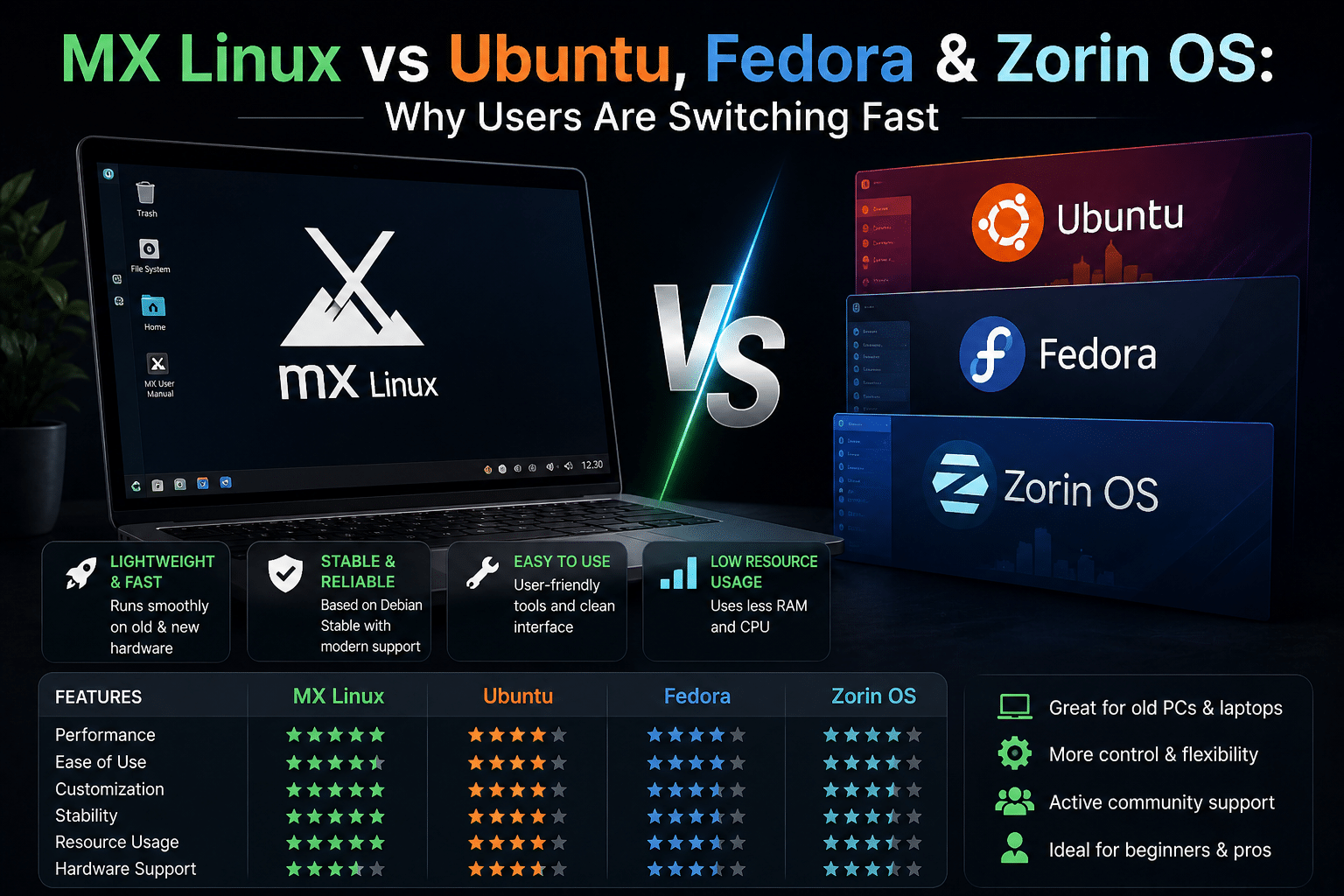
MX Linux vs Ubuntu, Fedora & Zorin OS: Why Users Are Switching Fast
The Linux ecosystem is evolving rapidly. For years, distributions like Ubuntu, Fedora, and Zorin OS dominated the conversation.
But something unexpected is happening.
MX Linux—a relatively low-profile distro—is climbing rankings, outperforming bigger names in user interest and engagement.
This isn’t hype. It reflects a deeper shift in how users evaluate Linux distributions in 2026.
Let’s break down why users are switching, backed by real data, performance insights, and practical use cases—and how solutions like HOMERDP amplify this trend.
The Data Behind MX Linux’s Rise
To understand the shift, we need to look at metrics like DistroWatch’s Hits Per Day (HPD):
- MX Linux consistently ranks in the top 3 distributions globally
- It has maintained this position for over 12 months, showing sustained interest
Important context:
These rankings measure user interest and research activity, not total installations.
Still, they reveal something critical:
Users are actively exploring alternatives to mainstream distros.
Why Users Are Switching to MX Linux
Let’s analyze the core reasons driving this migration.
1. Lightweight Performance That Beats Heavy Distros
One of MX Linux’s biggest advantages is efficiency.
System Requirements Comparison:
- MX Linux: ~512MB RAM minimum
- Ubuntu: ~4GB RAM recommended
That’s nearly an 8x difference.
Real-World Impact:
- Runs smoothly on older laptops
- Faster boot times
- Lower CPU and RAM usage
MX Linux uses XFCE by default, which is optimized for performance and minimal resource consumption.
Result:
Users frustrated with heavy systems like Ubuntu GNOME or Fedora Workstation are switching to MX Linux for speed.
2. Perfect Balance of Stability and Modern Features
MX Linux is based on Debian Stable, known for reliability.
But unlike pure Debian, MX adds:
- Updated kernels via Advanced Hardware Support (AHS)
- Newer graphics stack
- Performance tweaks
Result:
You get:
- Stability (like Debian)
- Modern hardware support (like newer distros)
This balance is something Ubuntu and Fedora struggle to perfect:
- Ubuntu → stable but sometimes bloated
- Fedora → cutting-edge but less stable for some users
3. Beginner-Friendly Without Losing Power
Modern Linux users want simplicity—but not limitations.
MX Linux delivers both.
Key Advantage: MX Tools
A powerful suite of GUI utilities that allows users to:
- Manage boot options
- Configure system settings
- Customize performance
Most tasks don’t require the terminal.
This is crucial because:
Many users leave Linux due to complexity—not lack of features.
MX Linux removes that barrier.
4. Superior Performance on Older Hardware
One of the biggest real-world drivers:
Reviving old machines.
MX Linux:
- Runs smoothly on 10+ year old systems
- Uses minimal RAM (often under 500MB idle)
Compare that to:
- Ubuntu / Zorin OS → designed for modern hardware
- Fedora → optimized for newer systems
Result:
Students, developers, and budget users are switching to MX Linux to extend hardware life.
5. No “Forced Ecosystem” Decisions
Ubuntu and others are increasingly opinionated:
- Ubuntu pushes Snap packages
- Fedora pushes bleeding-edge technologies
MX Linux takes a different approach:
It gives control back to the user
- Traditional package management (APT)
- No forced ecosystem choices
- More flexibility
This appeals strongly to power users and Linux purists.
6. Clean, Distraction-Free Desktop Experience
MX Linux focuses on productivity.
- Minimal UI clutter
- Customizable themes
- XFCE optimized workflow
Compared to:
- GNOME (Ubuntu/Fedora) → heavier, more opinionated
- Zorin OS → UI-focused but heavier
Result:
Users who value efficiency over aesthetics prefer MX Linux.
7. Strong Community and Long-Term Reliability
MX Linux may not have flashy marketing—but it has:
- A dedicated community
- Consistent updates
- Long-term stability
It has even ranked #1 on DistroWatch for multiple years
Result:
Trust builds over time → more users switch.
Why Users Are Leaving Ubuntu, Fedora & Zorin OS
Let’s be honest—these distros are still excellent.
But users are switching due to specific pain points:
Ubuntu
- Higher system requirements
- Snap ecosystem concerns
- Heavier desktop environment
Fedora
- Short release lifecycle
- Frequent updates can break workflows
Zorin OS
- Focused more on UI than performance
- Less flexibility for advanced users
Key Insight:
Users are prioritizing performance + control + efficiency over brand popularity.
Where HOMERDP Changes the Game
Now let’s connect this to a bigger trend.
Even the best distro has limits:
- Hardware constraints
- GPU limitations
- Resource bottlenecks
This is where HOMERDP becomes a strategic advantage.

HOMERDP + MX Linux = Ultimate Performance Stack
1. Run MX Linux on High-Performance Infrastructure
- Deploy MX Linux on powerful remote servers
- Eliminate hardware limitations
2. Access Anywhere
- Use your Linux environment from any device
- Ideal for students, developers, remote teams
3. Scale Instantly
- Upgrade RAM, CPU, GPU on demand
- No need to buy new hardware
4. Secure and Isolated Workflow
- Combine Linux security with remote infrastructure
- Safe for development and testing
Real-World Use Case
Scenario: Student Developer
Needs:
- Lightweight OS
- Coding tools
- Low-cost setup
Without HOMERDP:
- Old laptop struggles with performance
With MX Linux + HOMERDP:
✔ Runs fast locally
✔ Offloads heavy tasks to cloud
✔ Achieves 2–4x productivity boost
The Bigger Trend: Linux Is Changing
This shift reveals something important:
Linux users are becoming more performance-aware and intentional
They no longer choose distros based on popularity.
Instead, they choose based on:
- Efficiency
- Control
- Hardware compatibility
- Workflow optimization
Final Takeaways
✔ Why users are switching to MX Linux:
- Lightweight performance
- Stability + modern features
- Beginner-friendly tools
- Works on old hardware
- Greater control
✔ Why it’s outperforming Ubuntu, Fedora, Zorin:
- Lower resource usage
- Less forced ecosystem decisions
- Better optimization
✔ Where HOMERDP fits:
- Removes hardware limits
- Enhances performance
- Enables cloud-powered Linux workflows
Conclusion
The rise of MX Linux isn’t accidental—it reflects a fundamental shift in user priorities.
From popularity → to performance
From branding → to efficiency
From general-purpose → to optimized workflows
And when combined with HOMERDP, MX Linux becomes even more powerful:
Lightweight OS + Cloud Performance = Future of Linux computing
EXPLORE MORE ; How to Use lspci in Linux to Detect GPUs, Network Cards

READ OUR BLOGS