

Why Zenclora Linux Is One of the Fastest Lightweight Distros in 2026
The Linux ecosystem is known for innovation, efficiency, and customization. Over the years, many lightweight distributions have emerged to deliver faster performance and minimal resource consumption. In 2026, one name that has begun attracting attention among developers, system administrators, and Linux enthusiasts is Zenclora Linux.
Zenclora focuses on a simple but powerful philosophy: remove unnecessary software, streamline system processes, and deliver maximum performance with minimal system overhead. While many operating systems include dozens of pre-installed applications and background services, Zenclora offers a clean, minimal environment where users install only what they truly need.
This approach makes Zenclora one of the fastest lightweight Linux distributions available today. From rapid boot times to efficient package management and optimized system components, the distro is designed to provide a smooth and responsive experience.
In this article, we explore what makes Zenclora Linux so fast, how it compares with traditional distributions, and why developers are increasingly running it on high-performance remote environments such as HOMERDP GPU RDP servers.
The Rise of Lightweight Linux Distributions
Modern operating systems often come bundled with a large number of applications, services, and background processes. While these features may enhance convenience for casual users, they often lead to:
- Increased RAM consumption
- Slower system performance
- Longer boot times
- Higher storage usage
Lightweight Linux distributions solve this problem by reducing system bloat and optimizing performance.
Over the past decade, distributions like Debian minimal installs, Arch Linux, and Alpine Linux have become popular among developers who want a fast and clean system. Zenclora follows the same philosophy but introduces a more streamlined and user-friendly approach.
Instead of forcing users to manually configure everything from scratch, Zenclora provides a ready-to-use minimal environment with modern tools and optimized defaults.
What Is Zenclora Linux?
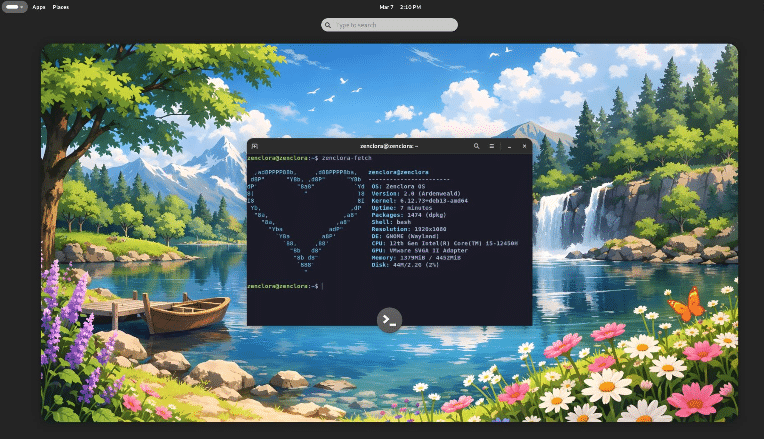
Zenclora Linux is a Debian-based distribution designed for speed, simplicity, and efficiency. The system eliminates unnecessary components while retaining essential tools for development, productivity, and system management.
Key goals of Zenclora include:
- Minimal software footprint
- High system responsiveness
- Simplified system management
- Efficient package handling
- Developer-friendly environment
The distribution targets users who prefer performance over pre-installed software.
Unlike many traditional operating systems, Zenclora allows users to build their system exactly the way they want, installing only the applications they need.
Key Reasons Why Zenclora Is So Fast
Several technical design choices make Zenclora one of the fastest Linux distributions available today.
1. Zero-Bloat Philosophy
One of Zenclora’s most important features is its zero-bloat design.
Many operating systems come with:
- Office suites
- Multimedia tools
- background services
- bundled utilities
Zenclora removes these unnecessary components and provides only the core system environment.
Benefits include:
- Faster startup time
- Lower memory usage
- Reduced CPU load
- Improved system stability
This minimal architecture ensures that system resources remain available for actual workloads instead of background processes.
2. Lightweight System Architecture
Zenclora is built with efficiency in mind. Its architecture reduces overhead in several areas:
- optimized kernel configuration
- minimal system services
- streamlined desktop environment
- efficient file management
As a result, the operating system can run smoothly even on older hardware or limited-resource environments.
At the same time, it scales extremely well on high-performance servers and cloud machines.
3. Efficient Package Management with ZPM
A major innovation introduced by Zenclora is the Zen Package Manager (ZPM).
Traditional Linux distributions often rely on multiple package management utilities, which can sometimes complicate system maintenance.
ZPM simplifies this process by offering a unified package management interface that allows users to:
- install applications quickly
- manage repositories
- update the system
- optimize packages
With simplified commands, users can install applications faster and maintain a cleaner system environment.
This streamlined approach reduces configuration complexity while improving overall system performance.
4. Optimized Desktop Experience
Many lightweight distributions sacrifice usability in the pursuit of performance. Zenclora aims to balance speed with usability by offering a minimal yet modern desktop experience.
The customized desktop environment focuses on:
- faster window rendering
- reduced graphical overhead
- efficient system resource usage
- distraction-free interface
This ensures that users enjoy a smooth and responsive graphical environment without unnecessary visual clutter.
5. Built-In GPU Compatibility
Modern workloads often rely heavily on GPU acceleration, especially in areas like:
- artificial intelligence
- machine learning
- gaming
- graphics rendering
- video editing
Zenclora simplifies GPU support by making driver installation easier and improving compatibility with GPU frameworks.
This feature makes the distro attractive for developers and researchers working with GPU-powered applications.
Zenclora for Developers and Engineers
Developers often prefer minimal operating systems because they provide clean environments for building and testing software.
Zenclora offers several advantages for development workflows.
Faster Development Environment Setup
Developers can install only the tools they need, such as:
- programming languages
- container tools
- development frameworks
- code editors
This keeps the system clean and avoids unnecessary conflicts.
Improved System Performance
Compiling large software projects requires significant CPU and RAM resources.
A minimal operating system ensures that:
- system resources are available for builds
- background tasks do not slow down development
- performance remains consistent during heavy workloads
Better Container and DevOps Support
Lightweight distributions are often preferred in containerized environments.
Zenclora works well with:
- Docker
- Kubernetes
- cloud infrastructure
- DevOps pipelines
Its small footprint makes it ideal for modern development workflows.
Running Zenclora on High-Performance Remote Infrastructure
While Zenclora runs efficiently on local machines, it becomes even more powerful when deployed on high-performance remote servers.
This is where HOMERDP’s advanced RDP servers provide significant advantages.
Remote desktop servers allow developers to run Linux systems with:
- powerful CPUs
- large memory resources
- GPU acceleration
- fast internet connectivity
Instead of being limited by local hardware, users can work from anywhere while accessing powerful remote infrastructure.
How HOMERDP Enhances Zenclora Workflows
Using Zenclora on HOMERDP’s GPU RDP servers provides several benefits for developers, engineers, and tech professionals.
1. High-Performance Computing Power
Large software builds and development workloads require strong computing resources.
HOMERDP servers provide:
- multi-core CPUs
- high RAM capacity
- fast NVMe storage
This ensures faster compilation times and smoother performance.
2. GPU-Accelerated Development
Developers working with AI frameworks, simulations, or graphics tools benefit greatly from GPU acceleration.
HOMERDP GPU servers enable:
- machine learning experiments
- CUDA-based applications
- AI model training
- graphics-intensive workloads
Running Zenclora on such infrastructure allows developers to combine lightweight OS efficiency with powerful hardware resources.
3. Remote Access From Anywhere
Modern professionals often work across multiple devices.
With HOMERDP, users can access their Zenclora environment from:
- laptops
- desktops
- tablets
- mobile devices
This provides flexibility and convenience without sacrificing performance.
4. Ideal for Testing and Experimentation
Developers frequently test different tools, libraries, and operating systems.
Using remote RDP environments allows them to:
- create multiple system instances
- run isolated testing environments
- experiment without risking local systems
Zenclora’s minimal architecture makes it perfect for such testing environments.
Zenclora vs Traditional Linux Distributions
| Feature | Zenclora Linux | Traditional Linux Distros |
|---|---|---|
| System size | Minimal | Larger |
| Pre-installed apps | Very few | Many |
| Performance | Extremely fast | Moderate |
| Resource usage | Low | Medium |
| Customization | High | Moderate |
Zenclora stands out because it combines minimalism with modern usability.
Users get the benefits of a lightweight system without sacrificing essential features.
The Future of Minimal Linux Systems
As computing shifts toward cloud infrastructure, remote development, and containerized applications, lightweight operating systems are becoming more important than ever.
Developers and companies increasingly prefer systems that:
- start quickly
- use fewer resources
- scale efficiently in cloud environments
- run smoothly on remote servers
Zenclora fits perfectly into this new computing model.
When paired with powerful remote infrastructure like HOMERDP GPU RDP servers, it becomes an excellent platform for modern development workflows, AI experimentation, and cloud computing.
Final Thoughts
Zenclora Linux represents a new generation of lightweight operating systems built around speed, simplicity, and efficiency.
Its zero-bloat philosophy, streamlined architecture, and unified package management system make it one of the fastest lightweight Linux distributions in 2026.
For developers, engineers, and tech enthusiasts looking for a powerful yet minimal operating system, Zenclora provides an excellent platform.
When deployed on high-performance remote infrastructure such as HOMERDP GPU RDP servers, the combination becomes even more powerful—offering scalable computing resources, GPU acceleration, and secure remote access.
As the demand for fast, efficient, and cloud-friendly operating systems continues to grow, Zenclora is well positioned to become a popular choice among modern developers and technology professionals.
EXPLORE MORE; Linux 7.1 vs Older Kernels
READ OUR BLOGS