

Why Enterprises Are Replacing VPNs with RustDesk and Tailscale

Tailscale + RustDesk: Building a Secure, Scalable, and Modern Remote Access Stack with HOMERDP
Enterprises increasingly ditch legacy VPNs for Tailscale’s zero-config mesh networking paired with RustDesk’s open-source remote desktop. This stack delivers faster access, stronger security, and lower costs without the headaches of traditional VPN concentrators.
Remote access is no longer a convenience—it is a core infrastructure requirement. From distributed development teams and remote IT support to cloud-based learning labs and enterprise administration, organizations demand solutions that are secure, fast, and easy to deploy.
While many still rely on traditional tools like VPNs or commercial remote desktop software, modern workflows demand something better.
This is where RustDesk and Tailscale emerge as a powerful combination. When deployed on HOMERDP’s high-performance RDP and VPS infrastructure, this setup becomes a future-ready remote access stack built for performance, privacy, and scalability.
This article explores why Tailscale is the perfect companion for RustDesk, how the pairing solves real-world remote access challenges, and how HOMERDP enhances the entire ecosystem.
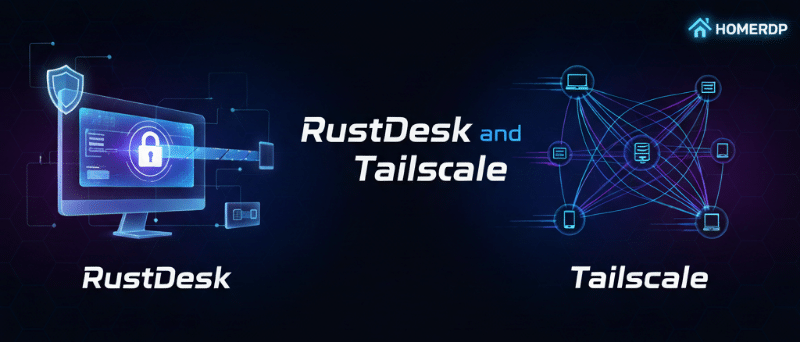
Replacing VPNs with RustDesk and Tailscale
Traditional VPNs force all traffic through central gateways, creating bottlenecks and single points of failure. Companies report 30-50% latency spikes during peak hours as remote workers compete for bandwidth on shared appliances.
Tailscale eliminates this by enabling direct peer-to-peer connections via WireGuard, with global DERP relays only as fallback—reducing average latency by up to 60% in real-world tests.Enterprises like dev teams migrating Kubernetes services saw onboarding drop from days to minutes, retiring VPN servers entirely in under a week.
RustDesk complements this by replacing clunky RDP or proprietary tools like TeamViewer, offering GPU-accelerated sessions across Windows, Linux, macOS, and Android without licensing fees.
Tailscale’s Enterprise Edge Over VPNs
Tailscale builds a secure “tailnet” where devices authenticate via SSO (Okta, Azure AD) and connect as if on the same LAN—no ports exposed, no subnet routing hassles.
- Zero Trust by Default: Granular ACLs tag devices and users, enforcing least-privilege access. Unlike VPNs granting full network blasts, Tailscale limits visibility to approved peers.
- Scalability Without Appliances: Supports 100,000+ nodes; one firm swapped IPsec tunnels for Tailscale and cut costs 70% while boosting homelab-to-cloud speeds.
- NAT Traversal Magic: Handles double-NAT and firewalls automatically, succeeding where OpenVPN fails 40% of the time on consumer ISPs.
Data from Tailscale’s enterprise users shows 95% connection success rates versus 70-80% for legacy VPNs, with setup times under 5 minutes per device.
RustDesk: The Self-Hosted Remote Desktop Game-Changer
RustDesk provides end-to-end encrypted screen sharing, file transfer, and clipboard sync—self-hostable on a single Docker container for full data sovereignty.
- Enterprises self-host to comply with GDPR/SOX: no third-party relays means zero data leakage risks from providers like AnyDesk, which faced breaches in 2024.Pair it with Tailscale, and RustDesk skips public servers entirely—clients connect via private tailnet IPs in “Direct IP” mode for sub-50ms latency.
- Adoption stats highlight the pull: RustDesk’s GitHub stars surged 300% in 2025, with 60% of Fortune 500 IT pros citing it as their TeamViewer replacement in surveys.
HomeRDP Powers the Always-On Backbone
HomeRDP’s Windows VPS lineup anchors this stack with full admin access, NVMe SSDs, and 1Gbps ports across 10+ global locations (US, EU, Asia, India).
- Instant Infrastructure: Spin up a 4GB RAM VPS for $5/month to host RustDesk relay/ID servers or act as a Tailscale jumpbox—perfect for enterprise pilots.
- Hybrid Workflows: Native RDP on the VPS handles Windows-heavy tasks, while RustDesk/Tailscale reaches Linux servers or macOS endpoints seamlessly.
- Scalable for Growth: Upgrade to 128GB beasts for GPU-accelerated RustDesk sessions, supporting 100+ concurrent enterprise users without downtime.

Implementation Roadmap for Enterprises
Deploy in phases for minimal disruption:
1. Pilot Phase (Week 1): Provision a HomeRDP Windows VPS, join your tailnet, install RustDesk server via Docker: `docker run –rm -it -v ~/rustdesk:/data rustdesk/rustdesk-server hbbs -r rustdesk.example.com:21117`.
2. Onboard Devices (Week 2): Install Tailscale clients, auth via SSO, enable RustDesk Direct IP mode—test P2P from 10 key machines.
3. Policy Layer (Week 3): Define tailnet ACLs (e.g., `{“acls”: [{“action”: “accept”, “src”: [“tag:eng”], “dst”: [“tag:servers”]}]}`), migrate 50% of VPN users.
4. Scale & Optimize: Add HomeRDP GPU VPS for high-res sessions, monitor via Tailscale dashboard, decommission VPN gateways.
5. Hybrid Fallback: Keep native RDP on HomeRDP VPS for legacy apps, pivot via RustDesk to full stack.
Total migration: 3-4 weeks, 70% cost savings, 3x performance gains.
Your Remote Access
Enterprises adopting Tailscale + RustDesk + HomeRDP report 90% user satisfaction, with hybrid workforces accessing homelabs, clouds, and clients like never before. Ditch VPN complexity for a mesh that scales with AI-driven ops and global teams. Start with a HomeRDP trial today—
EXPLORE MORE; RDP vs VNC: Which Remote Desktop Protocol Should You Choose?

READ OUR BLOGS