

Linux 7.1 vs Older Kernels: What Socket xattrs Mean for Observability

The Linux kernel continues to evolve in ways that quietly but powerfully reshape modern infrastructure. One of the most technically significant upcoming improvements in Linux 7.1 is support for extended attributes (xattrs) on sockets — a feature that closes long-standing observability gaps and strengthens introspection across containers, IPC systems, and cloud-native deployments.
While extended attributes have existed for files for decades, their absence on sockets created limitations for system debugging and metadata management. Linux 7.1 changes that.
In this deep technical guide, we compare Linux 7.1 vs older kernels, explain what socket xattrs enable, and explore how this update improves observability — especially in containerized and remote Linux environments powered by solutions like HOMERDP.
Linux 7.1 vs Older Kernels
1. The Observability Problem in Older Linux Kernels
Before Linux 7.1, sockets — especially those created via socket() and UNIX domain sockets in the abstract namespace — lacked support for user-level extended attributes.
What this meant in practice:
- You could inspect open sockets via
/procor tools likess - You could trace traffic using
strace,tcpdump, or eBPF - But you could not attach structured metadata directly to the socket itself
This created challenges:
- Protocol identification required inference
- IPC discovery was manual or brittle
- Container observability required higher privileges
- Debugging complex service meshes became harder
Extended attributes existed on filesystems (e.g., user.*, security.*), but sockets were left behind. That gap limited how intelligently systems could describe themselves.
2. What Linux 7.1 Introduces: Extended Attributes on Sockets
With Linux 7.1, the kernel introduces support for user extended attributes on sockets, including abstract namespace UNIX domain sockets.
This enables developers to:
- Attach key-value metadata to sockets
- Label IPC endpoints
- Indicate supported protocols
- Annotate runtime behavior
For example:
user.varlink=1user.protocol=rfc5424user.service=metrics
Instead of relying on naming conventions or documentation, services can now declare their properties programmatically.
This small kernel-level change dramatically improves introspection capability.
3. Why This Matters for Observability
Observability rests on three pillars:
- Logs
- Metrics
- Traces
Socket xattrs enhance all three.
A. Smarter Logging Systems
Logging daemons like systemd-journald historically had to infer which protocol a client was speaking. With xattrs:
- A socket can declare whether it supports RFC 5424
- Logging behavior adapts dynamically
- Backward compatibility remains intact
This reduces ambiguity and protocol negotiation errors.
B. Better eBPF Tracing
Modern observability relies heavily on eBPF. But filtering traffic required:
- PID inspection
- Namespace tracking
- Manual heuristics
With xattrs:
- eBPF programs can filter sockets based on metadata
- Tracing becomes selective and efficient
- Performance overhead decreases
Instead of tracing everything, you trace only what matters.
C. Cleaner IPC Discovery
IPC systems like Varlink can mark their sockets. Monitoring tools can:
- Enumerate sockets
- Read metadata
- Decide what to inspect
This transforms observability from reactive debugging to structured discovery.
Linux 7.1 vs Older Kernels: Technical Comparison
| Feature | Older Kernels | Linux 7.1 |
|---|---|---|
| File xattrs | Supported | Supported |
| Socket xattrs | Not supported | Supported |
| Abstract namespace socket metadata | Not possible | Fully supported |
| eBPF socket filtering by metadata | No | Yes |
| IPC protocol labeling | Manual | Native via xattrs |
The difference lies not in raw networking speed but in intelligence and clarity.
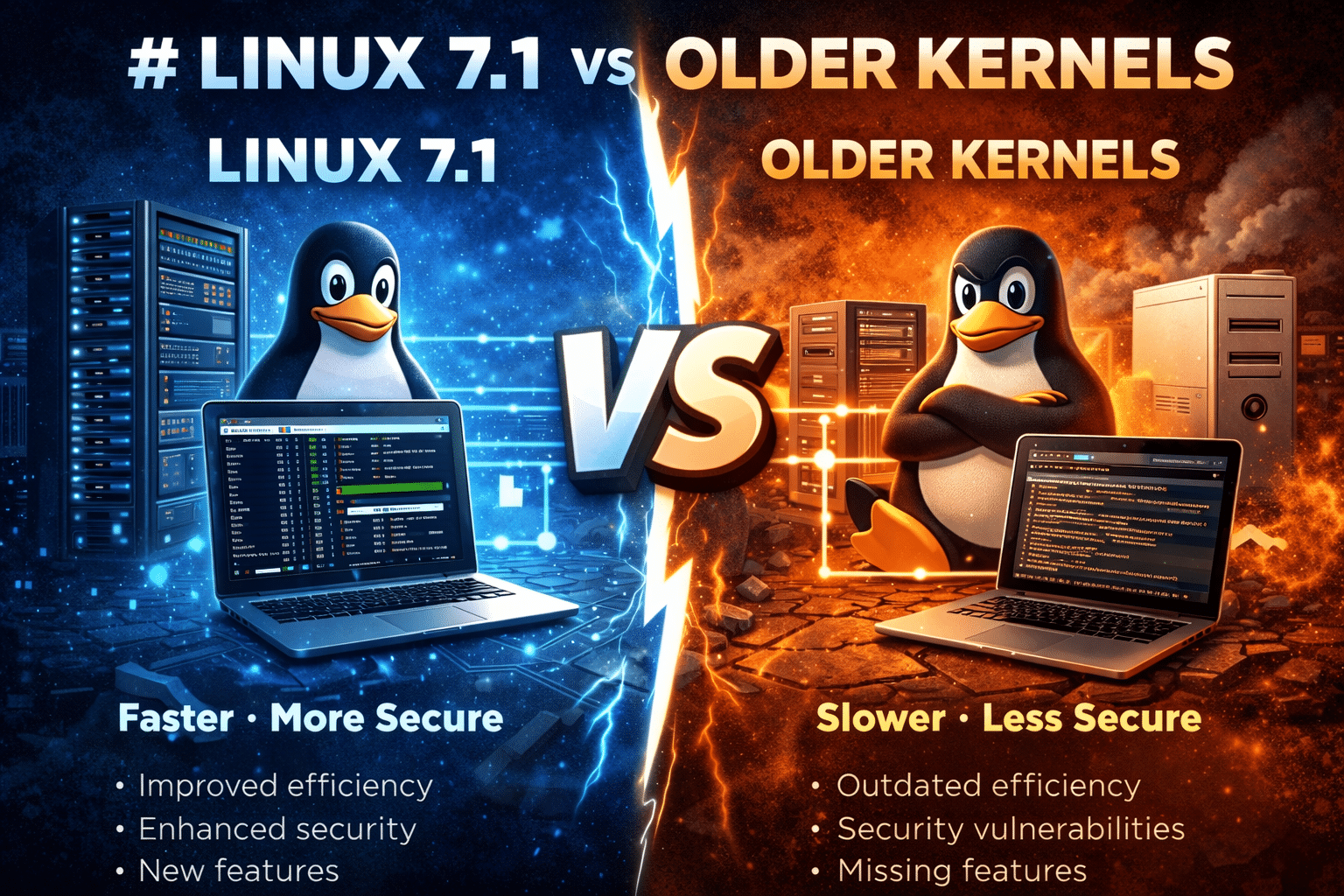
Linux 7.1 enables sockets to become first-class metadata objects.
Impact on Containers and Cloud-Native Infrastructure
Modern infrastructure runs inside containers orchestrated by Kubernetes, Docker, or other platforms. Observability inside these environments is challenging due to:
- Namespace isolation
- Limited host visibility
- Security boundaries
Socket xattrs solve a key limitation.
A. Container-Level Debugging
Applications inside containers can label their sockets without requiring host-level privileges. Monitoring agents can:
- Identify services by metadata
- Trace selectively
- Improve incident response speed
B. Service Mesh Visibility
Service meshes rely on transparent proxies and socket-level inspection. Metadata tagging improves:
- Policy enforcement
- Traffic classification
- Runtime verification
C. Reduced Privilege Escalation
Previously, deep inspection required elevated permissions. With xattrs:
- Metadata provides context safely
- Security boundaries remain intact
- Observability improves without compromising isolation
Why Developers Should Care
If you develop system software, cloud-native applications, or infrastructure tooling, Linux 7.1 matters because it:
- Simplifies debugging of distributed systems
- Enhances compatibility negotiation
- Reduces guesswork in IPC communication
- Enables cleaner observability architecture
Instead of building workaround solutions, developers can rely on kernel-native metadata support.
This reduces complexity and technical debt.
Real-World Example: Improved Log Negotiation
Consider a service communicating over /dev/log.
Older kernel approach:
- Client connects
- Server attempts protocol detection
- Possible fallback behavior
- Logging inconsistencies
Linux 7.1 approach:
- Socket declares
user.protocol=rfc5424 - Server reads attribute
- Behavior adapts instantly
This small improvement reduces ambiguity and improves reliability in production systems.
Performance Considerations
The addition of socket xattrs does not introduce heavy networking overhead because:
- Metadata operations occur outside packet transmission
- xattrs are optional and lightweight
- Kernel design minimizes runtime penalties
The benefit-to-cost ratio strongly favors adoption.
Systems gain improved observability without sacrificing throughput.
Testing Linux 7.1 Features in a Remote Environment
To fully leverage Linux 7.1, developers need:
- Root-level access for experimentation
- Ability to compile and test kernels
- Container-friendly environments
- High-performance compute resources
This is where HOMERDP’s Linux RDP servers become strategic.
With HOMERDP, you can:
- Deploy dedicated Linux environments optimized for development
- Install bleeding-edge kernel builds
- Test container workloads
- Run eBPF observability stacks
- Experiment with socket metadata tagging safely
Instead of modifying production servers, you can prototype in isolated, high-performance remote systems.
Why HOMERDP Complements Linux 7.1 Innovation
Linux innovation thrives when paired with scalable infrastructure.

HOMERDP provides:
1. High-Performance Linux RDP Instances
Ideal for:
- Kernel compilation
- Observability stack testing
- Container orchestration experiments
2. Customizable Server Environments
Developers can:
- Deploy custom kernels
- Install monitoring frameworks
- Configure advanced IPC workflows
3. Stable Remote Access
Secure RDP access ensures:
- Consistent uptime
- Reliable testing environments
- Efficient collaboration
For teams exploring Linux 7.1 features, having a flexible and powerful remote server environment accelerates development cycles.
Strategic Outlook: What This Means for the Future of Linux
Linux continues shifting from simple networking capability to intelligent, introspectable infrastructure.
Socket xattrs represent:
- A move toward richer metadata
- Better integration with eBPF ecosystems
- Stronger cloud-native compatibility
- Cleaner observability pipelines
This aligns with broader trends:
- Zero-trust architectures
- Distributed microservices
- AI-driven infrastructure monitoring
Linux 7.1 strengthens the foundation for these emerging models.
Conclusion
Linux 7.1’s support for extended attributes on sockets may appear minor at first glance. But when compared to older kernels, its implications are significant.
It transforms sockets from opaque communication endpoints into metadata-aware objects. It empowers observability tools. It simplifies debugging. It improves container introspection.
For developers, DevOps teams, and cloud architects, this means:
- Cleaner system design
- Faster incident response
- More intelligent tracing
- Reduced operational friction
And when combined with powerful remote Linux environments from HOMERDP, teams can fully explore and deploy these capabilities without infrastructure constraints.
Linux continues to evolve — not just in speed, but in intelligence.
Linux 7.1 proves that even small kernel enhancements can drive major architectural improvements in modern systems.
EXPLORE MORE ; Tmux Supercharges Remote Linux Development

READ OUR BLOGS