

CachyOS Delivers Up to 23% More Performance Than Pop!_OS on High-End Hardware
The Linux desktop ecosystem has never been more competitive. Over the past few years, distributions have evolved far beyond simple package management choices. Today, Linux distributions differentiate themselves through kernel optimizations, scheduler enhancements, compiler tuning, filesystem improvements, and hardware-specific performance engineering.
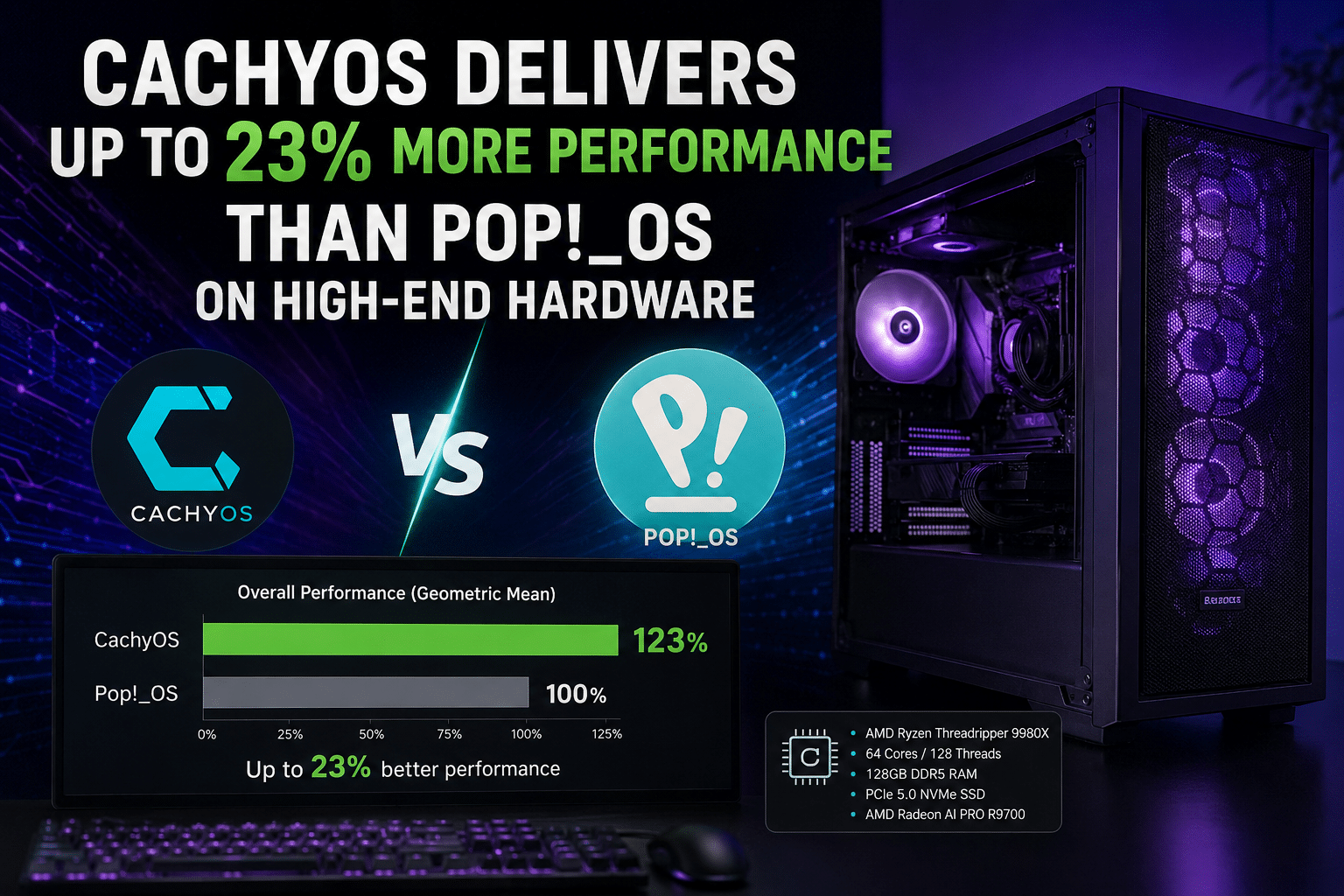
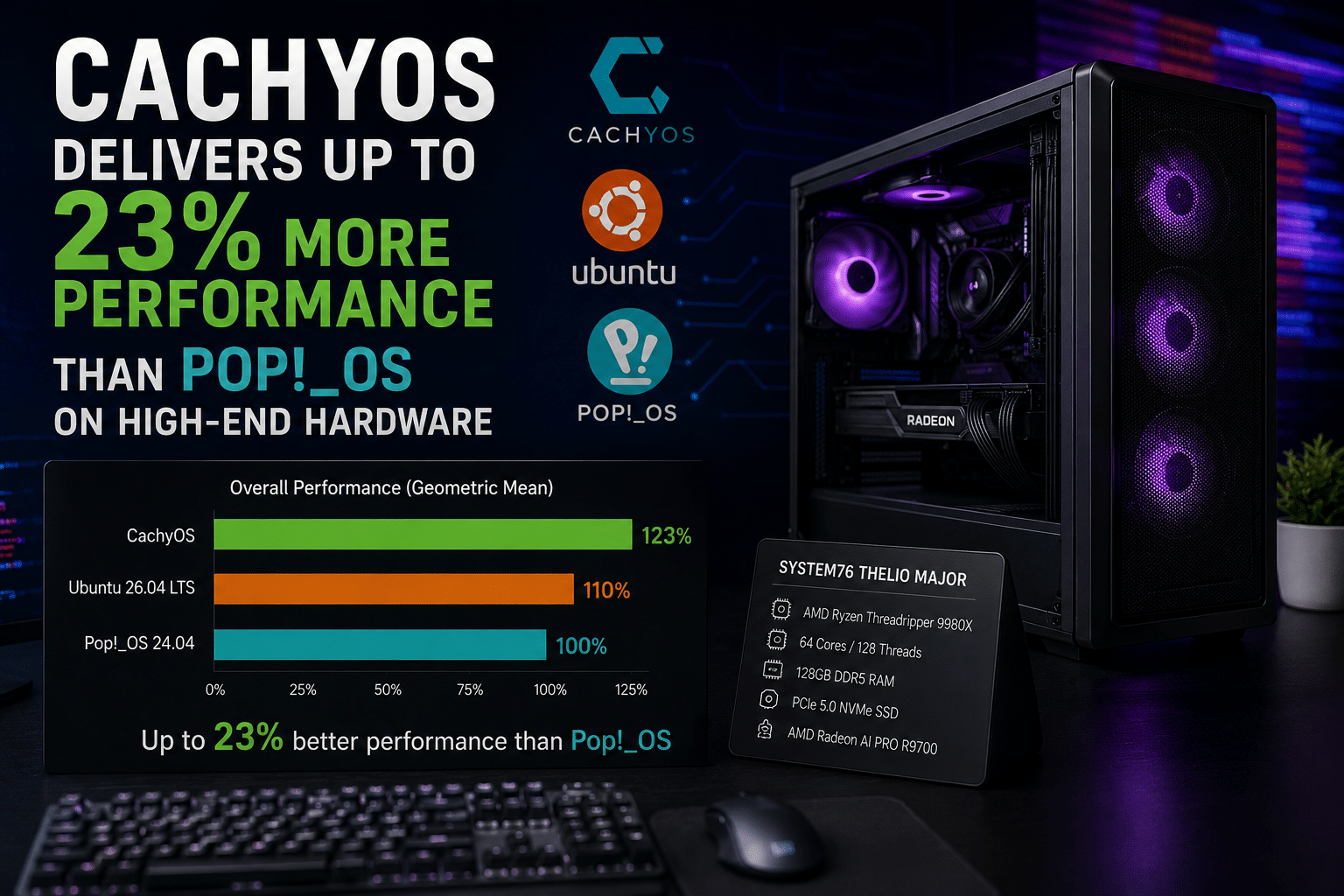
A recent benchmark study conducted by Phoronix on the powerful System76 Thelio Major workstation highlights just how much these optimizations can matter. The results show that CachyOS, a performance-focused Arch-based Linux distribution, significantly outperformed several popular competitors, including Ubuntu 26.04 LTS, Pop!_OS 24.04, and standard Arch Linux.
Most notably, CachyOS delivered up to 23% better overall performance than Pop!_OS on the same hardware platform.
For Linux enthusiasts, developers, DevOps professionals, AI engineers, content creators, and enterprises investing in high-performance workstations, these results provide valuable insights into the future of Linux computing.
More importantly, they reveal a growing trend: software optimization is becoming just as important as hardware selection.
Linux Performance Is Entering a New Era
For decades, Linux users selected distributions based primarily on factors such as:
- Stability
- Software repositories
- Community support
- Desktop environments
- Enterprise compatibility
Performance differences between major distributions were often relatively small.
That reality is changing.
Modern processors contain dozens of cores, sophisticated cache architectures, advanced power management systems, and highly complex scheduling requirements.
As hardware becomes increasingly powerful, operating systems have greater opportunities to optimize resource allocation and workload execution.
The result is a new generation of Linux distributions that focus specifically on extracting maximum performance from modern hardware.
CachyOS has emerged as one of the most prominent examples of this movement.
Understanding the Benchmark Environment
To understand the significance of the benchmark results, it is important to examine the testing environment.
Phoronix performed extensive testing using the latest generation System76 Thelio Major workstation.
This workstation represents one of the most powerful Linux systems currently available and serves as an ideal platform for evaluating distribution-level performance differences.
The hardware configuration included:
- AMD Ryzen Threadripper 9980X
- 64 Zen 5 CPU cores
- 128 processing threads
- 128GB DDR5 memory
- PCIe Gen 5 NVMe storage
- AMD Radeon AI PRO graphics
This is the type of hardware commonly used by:
- Software development teams
- AI researchers
- Data scientists
- Video production professionals
- CAD engineers
- Cloud infrastructure administrators
More than one hundred benchmarks were executed across a broad range of workloads.
These tests included:
- Software compilation
- Graphics rendering
- Image processing
- Video encoding
- Gaming workloads
- Scientific computing
- Productivity applications
- System-level performance measurements
The goal was simple: determine which Linux distribution could make the most efficient use of cutting-edge workstation hardware.
The Standout Result: Up to 23% Faster Than Pop!_OS
Among all tested distributions, CachyOS consistently delivered impressive performance.
The most eye-catching result came from the overall geometric mean of all benchmark tests.
According to the Phoronix analysis:
- CachyOS led approximately 37% of all tests
- Ubuntu 26.04 LTS led around 29%
- Arch Linux led roughly 29%
- Pop!_OS trailed significantly behind
When averaged across workloads, CachyOS achieved performance levels approximately 23% higher than Pop!_OS.
In the world of workstation computing, a 23% improvement is substantial.
For professionals running demanding workloads throughout the day, such gains can translate into:
- Faster project completion
- Reduced rendering times
- Quicker software builds
- Improved system responsiveness
- Better resource utilization
When multiplied across hundreds of daily tasks, even modest improvements can generate significant productivity benefits.
Why CachyOS Performs So Well

Many users wonder how one Linux distribution can outperform another when they all share the same Linux kernel foundation.
The answer lies in optimization.
CachyOS takes an aggressive approach to system performance.
Rather than prioritizing maximum compatibility with older hardware, it focuses on modern CPUs and contemporary workloads.
Several key design decisions contribute to its strong benchmark results.
1. Advanced CPU Scheduling
Modern processors contain dozens or even hundreds of logical execution threads.
Managing these resources efficiently requires intelligent scheduling.
CachyOS incorporates scheduler enhancements that help distribute workloads more effectively across available cores.
This becomes especially important on processors like the Threadripper 9980X, which features 64 physical cores.
Even small improvements in scheduling efficiency can generate noticeable performance gains.
2. Optimized Kernel Configuration
Kernel configuration plays a major role in system behavior.
Many mainstream distributions prioritize broad compatibility.
CachyOS instead emphasizes performance-oriented configurations that can reduce latency and improve throughput.
This strategy benefits:
- Compilers
- Database workloads
- AI applications
- Content creation software
- Virtualization platforms
3. Enhanced Compiler Optimization
The distribution uses modern compiler settings designed to leverage newer processor architectures.
Instead of targeting generic hardware profiles, CachyOS often takes advantage of instruction sets available on recent AMD and Intel processors.
This approach allows software to execute more efficiently.
4. Modern Software Stack
Performance improvements do not come exclusively from the kernel.
Graphics drivers, libraries, system services, and user-space applications all influence overall responsiveness.
CachyOS ships with an aggressively updated software stack that often includes newer performance improvements before they reach more conservative distributions.
Graphics Workloads Show Major Gains
One area where CachyOS excelled was graphics-related processing.
Many modern workflows involve intensive image manipulation and rendering tasks.
Applications such as:
- GIMP
- Krita
- Blender
- Darktable
- RawTherapee
rely heavily on CPU scheduling and graphics libraries.
The benchmark results showed CachyOS delivering excellent performance across multiple image-processing scenarios.
For creative professionals, this means:
- Faster filter application
- Reduced export times
- Improved rendering speeds
- Better workflow responsiveness
These benefits become increasingly valuable when working with high-resolution assets.
Video Encoding Performance Matters More Than Ever
Video content continues to dominate modern digital communication.
Organizations increasingly create:
- Marketing videos
- Product demonstrations
- Training materials
- YouTube content
- Social media clips
- Streaming content
Encoding efficiency therefore becomes a critical productivity factor.
The benchmarks demonstrated particularly strong results for CachyOS in AV1 encoding workloads.
AV1 is rapidly becoming the preferred codec for modern streaming platforms because it offers improved compression efficiency.
For creators and media professionals, better encoding performance can significantly reduce production bottlenecks.
Software Developers Stand to Benefit
Developers often overlook operating system optimization.
Many assume hardware upgrades provide the largest performance gains.
The benchmark results suggest otherwise.
Development workloads frequently include:
- Large code compilations
- Container builds
- Continuous integration tasks
- Virtual machine management
- Database testing
- Local Kubernetes environments
These workloads place significant demands on CPU scheduling and memory management.
A performance-focused distribution can reduce waiting time throughout the development process.
Even a few seconds saved during repeated build cycles can accumulate into hours of productivity gains each month.
The Impact on AI and Machine Learning
Artificial intelligence workloads continue to expand across industries.
Engineers increasingly use Linux workstations for:
- Model training
- Data preprocessing
- Inference testing
- Dataset preparation
- GPU acceleration
Many of these tasks rely on efficient CPU utilization in addition to GPU performance.
As AI workloads become more common, operating system optimization becomes increasingly important.
Distributions capable of maximizing resource efficiency provide tangible advantages for researchers and engineering teams.
What About Ubuntu and Pop!_OS?
The benchmark results should not be interpreted as criticism of Ubuntu or Pop!_OS.
Both remain excellent Linux distributions.
Ubuntu continues to dominate enterprise deployments because of:
- Long-term support
- Extensive documentation
- Broad software compatibility
- Commercial ecosystem support
Similarly, Pop!_OS remains one of the most user-friendly Linux distributions available.
Its strengths include:
- Excellent hardware integration
- Developer-friendly tools
- Strong desktop experience
- User accessibility
However, these distributions pursue broader goals than pure performance.
CachyOS specifically targets users who prioritize speed and responsiveness above all else.
This specialization helps explain its benchmark success.
The Growing Importance of Remote Linux Workstations
While local performance remains important, the way professionals use Linux systems is changing.
Increasing numbers of organizations now operate distributed teams.
Engineers frequently work from:
- Home offices
- Co-working spaces
- Client locations
- Different countries
- Hybrid work environments
As a result, high-performance Linux workstations increasingly need secure remote accessibility.
The ability to access workstation-class resources from anywhere is becoming just as important as local performance.
Why HOMERDP ?
This shift creates opportunities for remote desktop solutions designed specifically for professional workloads.
Organizations that invest in powerful Linux systems often need a reliable way to access those systems remotely.
This is where HOMERDP becomes particularly valuable.
HOMERDP complements performance-focused Linux environments by helping teams:
Access Workstations Remotely
Developers and engineers can connect to powerful Linux environments without being physically present.
Centralize Computing Resources
Rather than purchasing expensive workstation hardware for every employee, organizations can deploy centralized resources accessible through remote connections.
Support Distributed Teams
Remote workers gain consistent access to development environments regardless of location.
Improve Infrastructure Management
System administrators can manage Linux servers, cloud resources, and production environments through secure remote sessions.
Enhance Scalability
As workloads grow, organizations can scale infrastructure more efficiently while maintaining accessibility.
In many cases, combining a high-performance Linux distribution such as CachyOS with a flexible remote-access solution allows teams to maximize both performance and operational efficiency.
Linux Optimization Is Becoming a Competitive Advantage
The benchmark results reveal a broader industry trend.
Hardware innovation remains important, but software optimization is becoming an increasingly significant differentiator.
Organizations now invest heavily in:
- Faster processors
- Larger memory pools
- High-speed storage
- Advanced GPUs
Yet these investments can only reach their full potential when paired with optimized software.
CachyOS demonstrates how intelligent system engineering can unlock additional performance without requiring any hardware changes.
For businesses seeking greater efficiency, this approach can offer an attractive return on investment.
The Future of Performance-Focused Linux Distributions
The success of CachyOS suggests that performance-focused distributions may continue gaining popularity.
Several factors support this trend:
AI Workloads Continue Growing
Artificial intelligence applications place enormous demands on hardware resources.
Content Creation Is Expanding
Video production, streaming, and digital media creation require increasingly powerful systems.
Remote Development Is Mainstream
Distributed engineering teams need responsive computing environments.
Hardware Costs Are Rising
Organizations want maximum value from expensive workstation investments.
Linux Adoption Continues to Increase
More developers, creators, and businesses are embracing Linux-based workflows.
These factors create strong incentives for continued operating system optimization.
Final Thoughts
The latest workstation benchmarks provide compelling evidence that Linux distribution choice can significantly influence real-world performance.
CachyOS demonstrated impressive results on one of the most powerful Linux workstations available today, outperforming Ubuntu, Arch Linux, and particularly Pop!_OS in numerous workloads.
The headline figure—up to 23% better overall performance than Pop!_OS—highlights the growing importance of operating system optimization in modern computing.
For developers, AI researchers, content creators, DevOps teams, and enterprise users, these findings reinforce an important lesson:
Hardware alone does not determine performance.
The software layer matters just as much.
As Linux continues evolving, the combination of optimized distributions, modern hardware, and flexible remote-access platforms such as HOMERDP will help define the next generation of professional computing environments.
Organizations that embrace both performance and accessibility will be best positioned to maximize productivity in an increasingly distributed and demanding digital landscape.
EXPLORE MORE ; Why LXC & Docker Outperform Traditional VMs on HOMERDP

READ OUR BLOGS