

LineageOS Shows the Future of Android Isn’t Just About AI
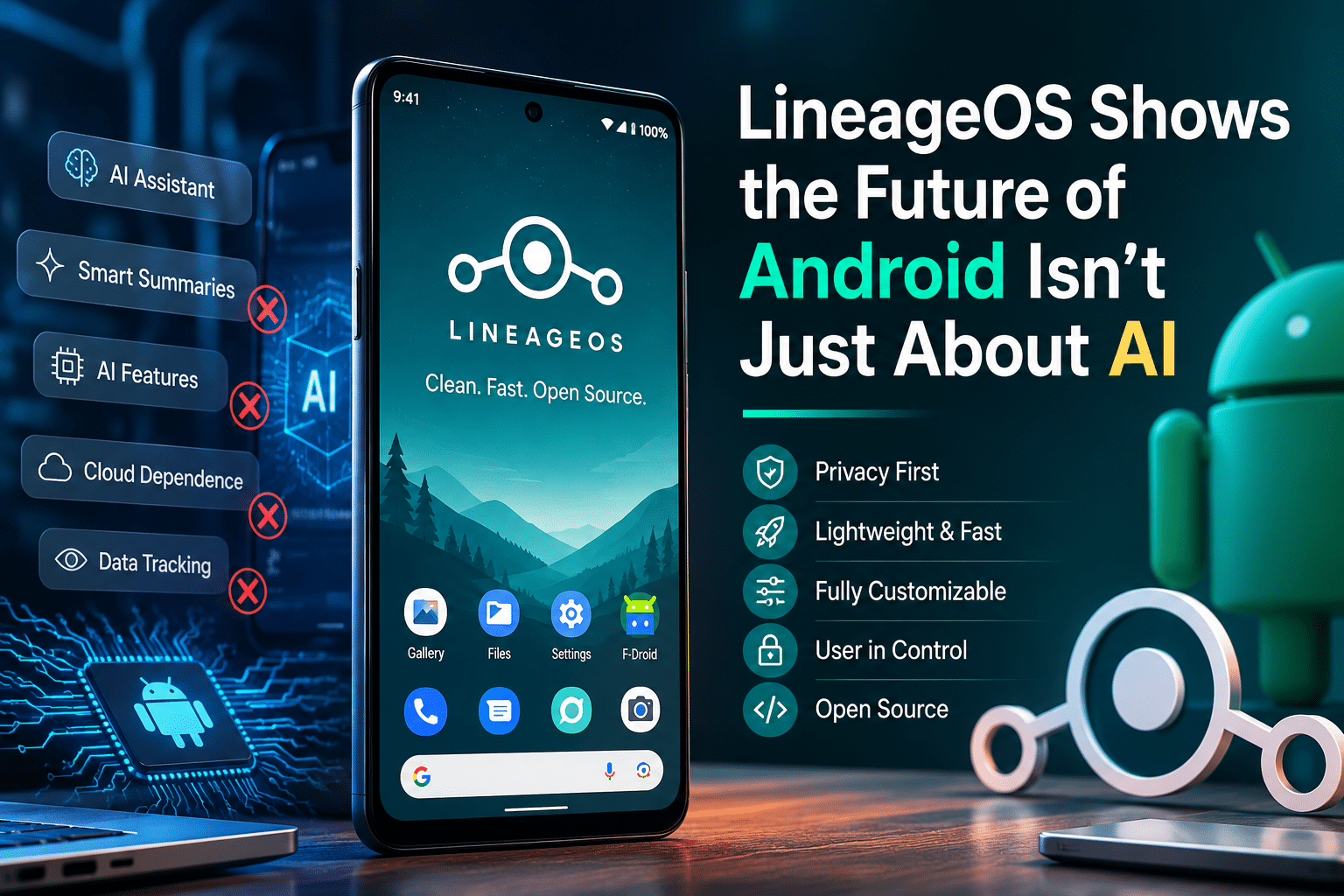
Artificial intelligence has become the defining buzzword of the smartphone industry.
Every major Android manufacturer now wants its devices to do more with AI. Smartphones can summarize notifications, edit photographs with generative tools, translate conversations, remove objects from images, assist with writing, search through personal content, and increasingly perform tasks on the user’s behalf.
Those capabilities can be useful. But there is a growing question underneath the AI race:
Does adding more AI actually make Android better?
LineageOS offers an interesting answer: not necessarily.
The open-source Android distribution demonstrates that a premium-feeling smartphone experience can come from fundamentals that have existed long before generative AI became mainstream—clean software, responsiveness, customization, privacy choices, long-term community support, and user control.
That makes LineageOS particularly relevant in 2026. The project remains actively developed, maintains an official device ecosystem, and continues to evolve alongside Android. LineageOS describes itself as a free and open-source operating system based on the Android mobile platform, while its official device database currently includes hardware from numerous manufacturers.
The bigger lesson is not that Android should reject AI.
It is that AI should be one part of the Android experience—not the definition of a good Android experience.
The Smartphone Industry Has Entered the AI Era
Walk into a smartphone store today and AI is difficult to avoid.
Manufacturers use AI to differentiate devices that otherwise share remarkably similar hardware.
A modern flagship may already include:
- High-refresh-rate OLED displays
- Powerful multi-core processors
- Large RAM capacities
- Fast flash storage
- Advanced camera sensors
- 5G connectivity
- Fast charging
- Satellite or emergency communication features
- Sophisticated biometric security
- Long software-support commitments
Once smartphones reach this level, manufacturers need new ways to convince customers to upgrade.
AI provides an obvious answer.
Instead of advertising only a faster processor, manufacturers can promote an AI assistant.
Instead of simply improving a camera, they can advertise generative photo editing.
Instead of improving search, they can add an AI-powered search experience.
Instead of presenting a normal voice recorder, they can offer automatic transcription and summaries.
None of those features are inherently bad.
The problem begins when the industry starts treating AI as synonymous with innovation.
A smartphone can have impressive AI capabilities and still feel frustrating if:
- Apps launch slowly.
- Animations stutter.
- Notifications become overwhelming.
- The interface contains unnecessary software.
- Background services consume resources.
- Users cannot customize basic behavior.
- The manufacturer stops updating the phone too soon.
This is precisely where LineageOS presents an alternative philosophy.
What Is LineageOS?
LineageOS is a free and open-source operating system for supported smartphones and tablets, built on the Android platform. It is the successor to CyanogenMod and has developed a substantial ecosystem around alternative Android software.
The project is particularly interesting because it does not compete with smartphone manufacturers by trying to offer more artificial intelligence.
Instead, it focuses heavily on the underlying Android experience.
That means users can explore an Android environment that emphasizes:
- Customization
- Open-source development
- User control
- System-level configuration
- A relatively clean software environment
- Community-supported devices
- Alternative choices for Google applications and services
LineageOS also provides device-specific documentation and installation instructions through its official wiki.
This creates a fundamentally different relationship between the user and the smartphone.
The manufacturer says:
“Here is how we think your phone should work.”
A custom ROM community says:
“Here is a platform you can configure for yourself.”
That distinction is increasingly valuable.
1. A Premium Experience Starts With Speed
The first reason LineageOS challenges the AI-first smartphone narrative is simple:
Responsiveness matters.
Think about how often you interact with your phone every day.
You unlock it.
You open a messaging application.
You swipe through notifications.
You launch the camera.
You browse the web.
You switch between applications.
You adjust settings.
You scroll through social media.
You return to the home screen.
These interactions happen constantly.
Most of them do not require artificial intelligence.
They require an operating system that responds quickly.
A perfectly optimized interface can make a three-year-old smartphone feel surprisingly capable.
Conversely, an overloaded software environment can make powerful hardware feel slower than its specifications suggest.
This is why software efficiency remains one of the most underrated aspects of smartphone design.
A manufacturer can advertise an AI-powered assistant capable of summarizing a document, but if the phone regularly struggles with basic multitasking, the user will notice the fundamental problem first.
Premium software should feel invisible when it works correctly.
The user should not think about the operating system every time they open an application.
It should simply respond.
2. Less Bloat Can Make a Bigger Difference Than More AI
Android manufacturers frequently add proprietary applications and services to their devices.
Some are genuinely useful.
Others duplicate functionality already provided by Android or Google.
Users may encounter:
- Manufacturer browsers
- Manufacturer app stores
- Duplicate galleries
- Proprietary assistants
- Cloud services
- Promotional applications
- Device-management tools
- Carrier applications
- Preinstalled third-party software
Over time, these additions can make the operating system feel more complicated.
LineageOS approaches the software environment differently.
Users can install the operating system without automatically accepting every proprietary application associated with a traditional smartphone manufacturer.
Google Apps are optional components rather than a fundamental part of LineageOS itself; the official LineageOS documentation describes them as proprietary Google-branded applications such as the Play Store, Gmail, and Maps.
That distinction gives experienced users more control.
They can decide what belongs on their device.
And that is itself a premium feature.
Instead of asking how many features a phone can ship with, LineageOS encourages a different question:
How many features does the user actually want?
3. Customization Is More Important Than It Looks
Modern smartphones have become remarkably polished, but they can also be restrictive.
Manufacturers increasingly control:
- System interfaces
- Default applications
- Navigation behavior
- Notifications
- Lock-screen experiences
- System services
- Update mechanisms
- Bootloader policies
For many people, this is perfectly acceptable.
But advanced users often want something different.
They want to customize the device.
LineageOS has historically attracted users precisely because custom ROMs provide greater freedom over the Android environment.
That freedom creates a different definition of premium.
A premium device does not necessarily need to make every decision for the user.
Sometimes a premium device is one that lets the user make the decision.
This becomes especially important for developers, Linux enthusiasts, privacy-conscious users, and people who enjoy experimenting with technology.
4. LineageOS Keeps the Open-Source Spirit of Android Alive
Android itself has deep roots in open-source development through the Android Open Source Project.
LineageOS builds on those foundations.
The project’s source-oriented approach allows developers and contributors to participate in the evolution of the operating system.
That matters because proprietary smartphone software often feels like a finished product delivered to the customer.
Open-source projects can feel more like ongoing technical ecosystems.
Users can:
- Examine source code
- Report bugs
- Contribute patches
- Follow development
- Build software
- Study Android internals
- Experiment with configurations
That educational dimension makes LineageOS particularly valuable for technically minded users.
A smartphone stops being just a consumer product.
It becomes a computing platform.
5. Long-Term Hardware Value Could Be LineageOS’s Biggest Advantage
There is another reason LineageOS remains relevant:
It can help extend the useful life of compatible hardware.
Smartphones do not necessarily become physically incapable when manufacturers stop providing major Android updates.
A phone might still have:
- A capable processor
- A good display
- Working cameras
- Sufficient storage
- Functional connectivity
- A perfectly usable chassis
Yet the manufacturer may have moved its software-development resources to newer models.
Custom ROM projects create another path.
If a device has appropriate hardware support and an active maintainer community, an alternative operating system can potentially keep that hardware useful beyond its original software lifecycle.
LineageOS’s current device database demonstrates the breadth of hardware involved, covering products from manufacturers including Samsung, Motorola, Xiaomi, Google, Sony, ASUS, Lenovo, Nokia, Nothing and others.
That does not mean every old phone receives indefinite support.
It does not mean every unofficial build is secure.
And it certainly does not mean users should install random software on an unsupported device.
But the underlying concept is powerful:
Software can extend the useful life of hardware.
6. LineageOS Is Still Evolving With Modern Android
It would be a mistake to describe LineageOS as an old-school Android project that simply preserves an older version of the operating system.
The project continues to evolve.
In February 2026, LineageOS announced that it was officially using Google’s Material Expressive design system, bringing a more contemporary visual language to its interface.
The project’s development has also moved into Android 16-based releases.
For example, official device documentation for the Xiaomi Redmi 12C lists LineageOS 23.2 based on Android 16, while documentation for the Google Pixel 5 shows support history extending through Android 16-based LineageOS releases.
This matters.
LineageOS is not arguing that users should abandon modern Android.
It is showing that modern Android can evolve without making AI the center of every interaction.
7. Privacy Is About Control, Not Marketing
Privacy is another area where LineageOS deserves attention—but it also requires careful explanation.
It would be inaccurate to claim that installing LineageOS automatically makes a smartphone completely private.
It does not.
Privacy depends on:
- Which applications you install
- Which services you enable
- Whether you install Google Apps
- Application permissions
- Network behavior
- Device firmware
- Security updates
- Your own configuration
LineageOS can nevertheless give technically capable users more choices.
The ability to decide whether to install proprietary Google applications, for example, provides a degree of flexibility that a standard Android installation may not provide.
That is different from claiming that LineageOS is magically “private.”
The better argument is:
LineageOS gives users more control over the software environment.
And control is one of the most important foundations of privacy.
8. Security Still Requires Responsible Maintenance
The same nuance applies to security.
Open-source software does not automatically mean perfectly secure software.
A custom ROM can contain vulnerabilities.
A device can have outdated firmware.
A third-party application can compromise privacy.
An unsupported build can become dangerous.
LineageOS itself maintains specific device support and release infrastructure, and its 2026 updates demonstrate ongoing development across its ecosystem.
But users still need to understand their responsibilities.
Before installing LineageOS, they should verify:
- Whether their device is officially supported.
- Which Android version the current release uses.
- Whether the device receives current security patches.
- Whether firmware requirements are satisfied.
- Whether banking and DRM-dependent applications work as expected.
- Whether they can restore the manufacturer’s original software.
- Whether they have a complete backup.
A custom ROM should be treated as a technical project—not simply an app that can be installed with one tap.
9. The AI Debate Is Really About User Experience
The biggest misunderstanding in the AI-versus-LineageOS debate is assuming that the two approaches are mutually exclusive.
They are not.
There is nothing wrong with AI.
AI can be genuinely useful for:
- Translation
- Accessibility
- Photo editing
- Transcription
- Search
- Productivity
- Voice interaction
- Spam detection
- Communication
The problem is different.
The smartphone industry sometimes treats AI as if it automatically improves every part of the user experience.
It does not.
A badly designed AI feature remains badly designed.
An unnecessary AI feature remains unnecessary.
An AI service that consumes battery or requires a cloud connection for a simple task may be less useful than a traditional feature that works instantly offline.
Therefore, the real question is not:
“Does this phone have AI?”
The better question is:
“Does this feature make the phone better for the person using it?”
That is a much higher standard.
10. Premium Should Mean More Than Expensive
The word “premium” has become closely associated with expensive hardware.
A premium phone usually means:
- Higher price
- Better materials
- Better cameras
- Faster processors
- Brighter displays
- More features
But software should have its own definition of premium.
A premium operating system should be:
Fast
It should respond quickly.
Stable
It should behave predictably.
Secure
It should receive appropriate updates.
Flexible
It should allow users to configure important aspects.
Efficient
It should avoid wasting system resources.
Transparent
Users should understand what the software does.
Long-lived
It should help capable hardware remain useful.
Respectful
It should not constantly fight for the user’s attention.
These qualities existed before the AI smartphone era.
They will remain important after today’s AI features become ordinary.
LineageOS and the Right to Own Your Computing Experience
There is a philosophical argument underneath all of this.
When someone purchases a smartphone, who should control the computing environment?
The manufacturer?
The operating-system provider?
The application ecosystem?
Or the person who purchased the device?
The answer is complicated because smartphones depend on hardware security, proprietary firmware, carrier requirements, application certification, and commercial services.
But LineageOS pushes the conversation toward user ownership.
It says that the operating system can be an environment that users modify and understand rather than something they simply consume.
That is a powerful idea.
And it connects LineageOS to the broader open-source world.
From LineageOS to Linux: The Same Philosophy
The principles behind LineageOS should sound familiar to Linux users.
Linux distributions have spent decades demonstrating that operating systems can be customized.
Users can choose:
- Desktop environments
- Window managers
- Package managers
- File systems
- Kernels
- Applications
- Development tools
- Networking configurations
That philosophy also extends naturally into server computing.
A developer who enjoys customizing a smartphone may also want the freedom to configure a Linux server.
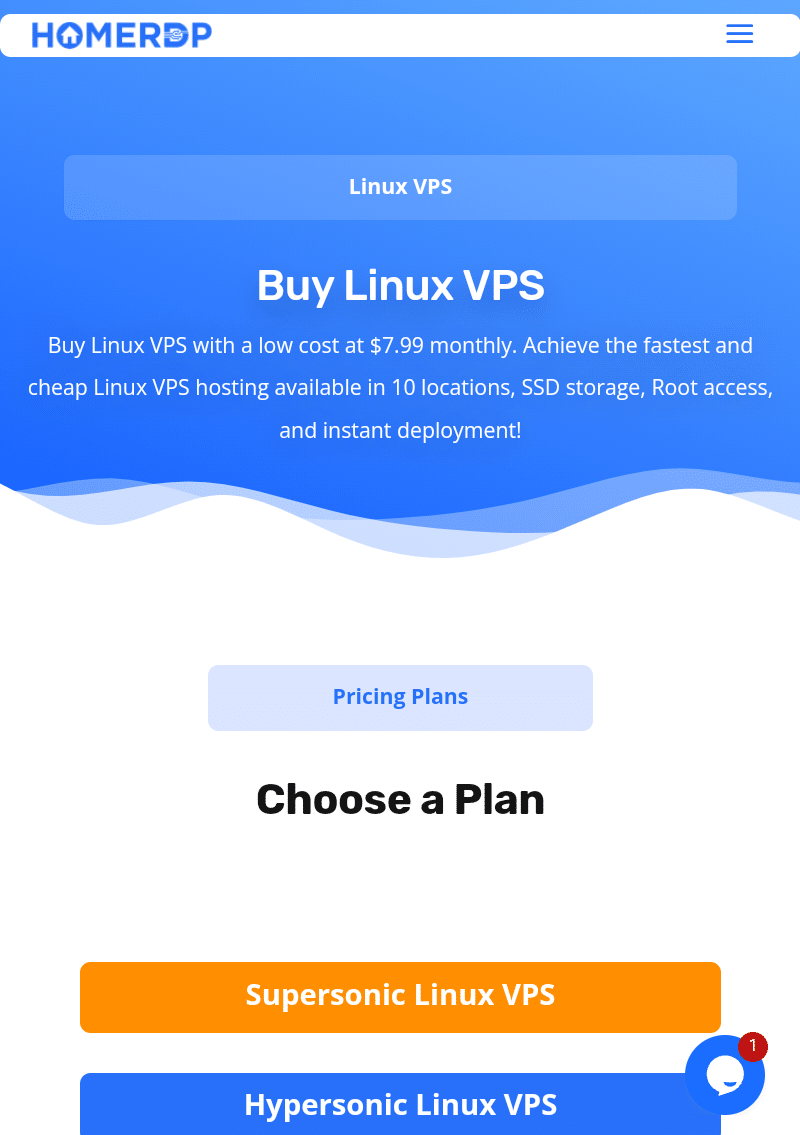
This is where HOMERDP’s Linux VPS service fits naturally into the conversation.
HOMERDP’s Linux VPS-related offerings emphasize features such as full root access, SSD/NVMe storage, scalable resources, and high-performance infrastructure. Its own technical material highlights how root access allows users to customize packages, firewall configurations, and other server-level settings.
The connection is straightforward.
LineageOS gives technically capable users greater control over a supported Android device.
A Linux VPS gives developers greater control over a remote Linux environment.
Both are examples of computing that becomes more useful when users can shape the environment around their needs.
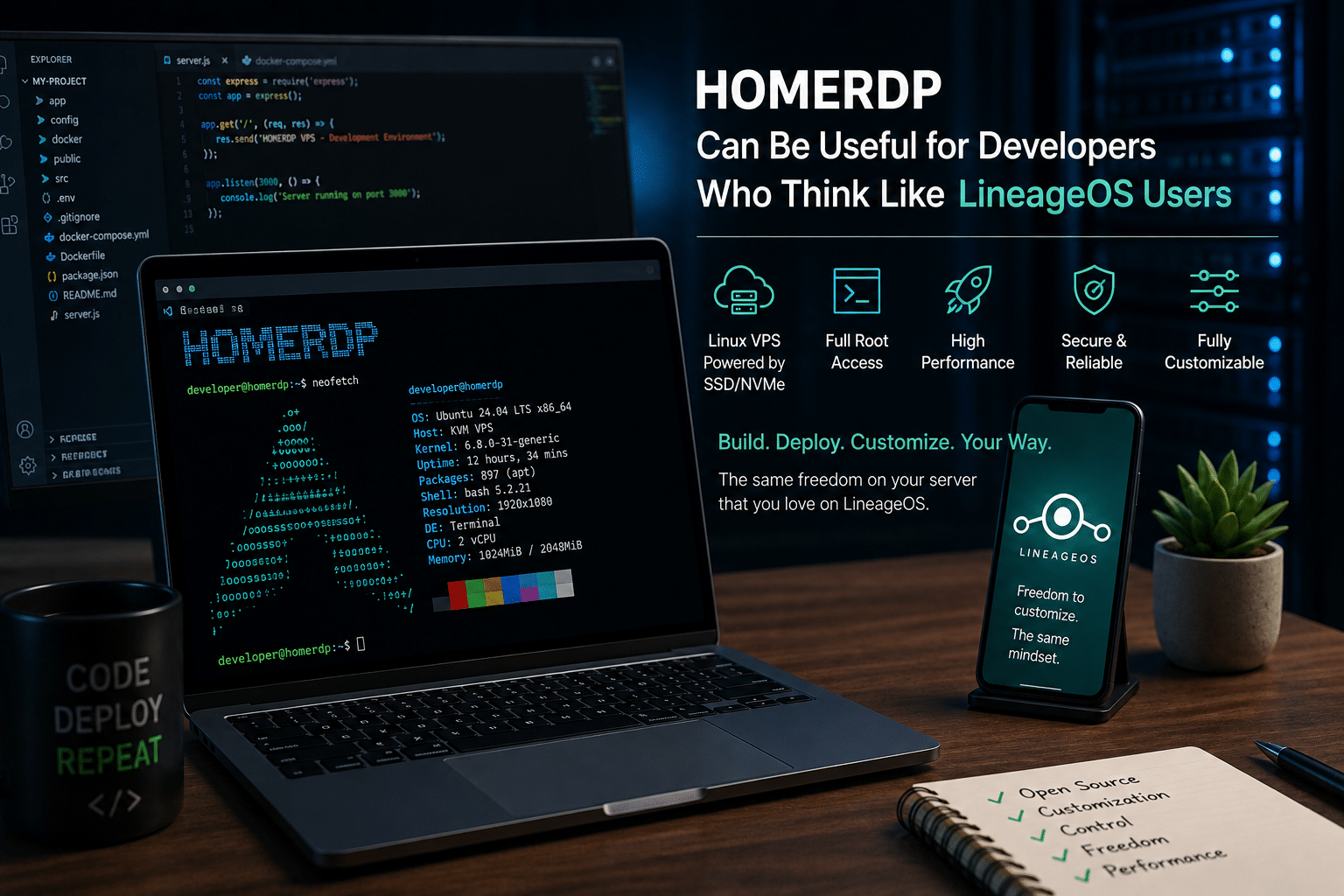
Why HOMERDP Can Be Useful for Developers Who Think Like LineageOS Users
The connection becomes even clearer when we look at practical development workflows.
Imagine a computer science student experimenting with:
- Linux administration
- Docker
- Web development
- Databases
- Networking
- APIs
- Git
- CI/CD
- Self-hosted applications
A local laptop is useful, but a remote Linux VPS creates another environment for experimentation.
With root access, the user can configure the server according to the requirements of a project.
For example:
Laptop → Git repository → Linux VPS → application deployment → testing → monitoring
The VPS can function as a persistent development or staging environment.
If the local laptop shuts down, the remote environment remains available.
If a student wants to experiment with a different server configuration, the remote environment keeps that work separate from the primary computer.
If a developer wants to test a web application from outside the local network, a remotely hosted Linux server provides a practical environment.
HOMERDP’s published Linux-focused material specifically discusses full root access, SSD/NVMe storage, scalable infrastructure, and server use cases involving development and containerized workloads.
This makes Linux VPS hosting a logical extension of the same control-first computing philosophy.
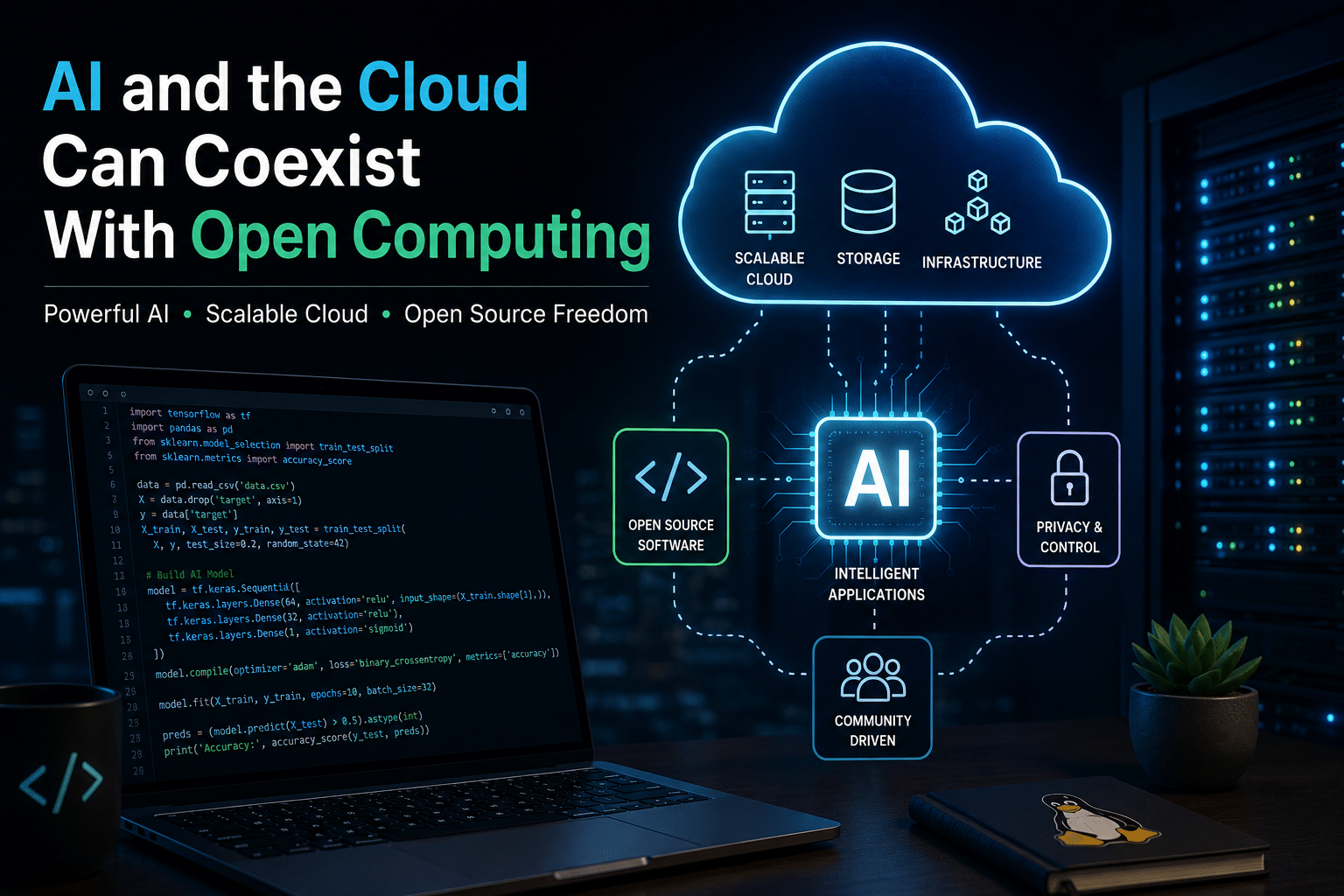
AI and the Cloud Can Coexist With Open Computing
There is another important lesson here.
The future does not need to be:
AI vs open source
or:
cloud vs local computing
or:
automation vs user control
The better future combines them.
A developer can use AI to generate code.
They can review that code themselves.
They can deploy it to a Linux VPS.
They can monitor the application.
They can modify the infrastructure.
They can choose which services communicate with external systems.
The same principle applies to smartphones.
A user can use an AI-powered application while still choosing an operating system that provides greater customization.
The important thing is who remains in control.
10 Things That Can Make Android Feel Premium Without AI
If manufacturers want to build genuinely premium Android experiences, they do not need to rely exclusively on AI.
They can improve the fundamentals.
1. Better performance
Reduce unnecessary background activity and optimize animations.
2. Cleaner software
Give users the option to remove applications they do not need.
3. Longer updates
Support hardware for as long as technically practical.
4. Better customization
Allow users to change more system-level behaviors.
5. Stronger privacy controls
Make permissions understandable and configurable.
6. Better battery efficiency
Optimize background services rather than simply increasing battery capacity.
7. Fewer unnecessary notifications
Let users decide which applications deserve attention.
8. Better accessibility
Build accessibility into the operating system rather than treating it as an afterthought.
9. More transparent software
Clearly explain what services run and why.
10. Greater user ownership
Give technically capable users meaningful options for modifying their devices.
None of these requires generative AI.
And every one of them can improve the everyday experience.
Why Older Phones Can Benefit Most
The AI smartphone race primarily targets new hardware.
LineageOS tells a different story.
An older phone can remain useful if its hardware is still capable and its software environment remains maintained.
Consider a hypothetical four-year-old smartphone with:
- 8 GB RAM
- A reasonably powerful ARM processor
- 128 GB storage
- A good OLED display
- 5G connectivity
The hardware might still handle messaging, browsing, media playback, coding-related tasks, document editing, and many everyday applications comfortably.
If the manufacturer’s software becomes outdated, replacing the entire phone may not be the only option.
A supported custom ROM can potentially provide another path.
This has environmental and economic implications.
Keeping a functioning device in use longer can reduce the pressure to purchase replacement hardware simply because software support has ended.
Again, this is not a guarantee.
Battery degradation, unsupported firmware, missing proprietary components, and application compatibility can still limit the usefulness of older devices.
But the principle deserves more attention.
Software longevity is hardware sustainability.
LineageOS Also Reminds Us That Choice Is Valuable
Technology companies often compete by reducing friction.
That sounds positive.
And often it is.
But too much automation can also reduce choice.
The system decides which application to use.
The manufacturer decides which services run.
The assistant decides what information is relevant.
The cloud decides where data is processed.
AI decides what should be summarized.
Convenience can gradually become dependency.
LineageOS represents a different model.
It does not eliminate convenience.
It gives technically capable users more opportunities to make decisions.
That is an important distinction.
The Limitations You Should Know Before Installing LineageOS
No serious article about custom Android software should ignore the downsides.
LineageOS is not the perfect choice for everyone.
Device compatibility varies
The first step is checking the official supported-device list. The project maintains device-specific documentation and builds rather than promising universal compatibility.
Installation requires technical knowledge
Depending on the device, installation can involve bootloader unlocking, recovery tools, firmware requirements, backups, and command-line utilities.
Some proprietary features may disappear
Manufacturer-specific camera processing, proprietary gestures, special hardware features, or other vendor software may not be available.
Google-dependent applications can be complicated
Applications that rely on Google services or device-integrity mechanisms may behave differently.
Security depends on the complete device stack
A current operating-system build cannot automatically solve vulnerabilities in unsupported firmware, bootloaders, or other proprietary components.
Updates are not identical across every device
The quality and frequency of support can vary by device and maintainer.
These are not reasons to dismiss LineageOS.
They are reasons to approach it intelligently.
The Future of Android Should Be About Choice
The most compelling lesson from LineageOS is not that AI has no place in Android.
AI clearly has a place.
The lesson is that Android’s future should offer choice.
Some users will want an AI-heavy smartphone that proactively summarizes their day, edits photographs automatically, and acts as a personal assistant.
Others will want a simple phone with minimal services, excellent performance, strong customization, and maximum control.
Both users are legitimate.
The Android ecosystem is healthier when it supports both.
LineageOS demonstrates that there remains a community for the second vision.
What “Premium Android” Should Mean in 2026
The smartphone industry should consider redefining premium.
Premium should not simply mean:
More AI + higher price + more hardware.
Instead, premium Android should mean:
Better performance + longer support + thoughtful design + privacy + customization + reliability + useful AI.
Notice the final position of AI.
It is still there.
But it is part of the experience rather than the entire experience.
That distinction matters.
A premium phone should make AI available when AI provides genuine value.
It should also remain excellent when the user simply wants to:
- Send a message
- Take a photograph
- Open a website
- Listen to music
- Read a document
- Check an email
- Adjust a setting
- Make a phone call
The fundamentals never become obsolete.
Final Verdict: LineageOS Has a Bigger Message Than Custom ROMs
LineageOS may look like a niche project compared with the enormous Android ecosystem.
But its philosophy carries a much bigger message.
The future of Android does not have to be defined entirely by AI.
AI can make smartphones more capable.
But capability is only one part of quality.
A truly premium Android experience also needs:
- Speed
- Stability
- Efficiency
- Customization
- Security
- Privacy
- Longevity
- Transparency
- User control
LineageOS continues to demonstrate the value of those principles while evolving alongside newer Android releases. Its current ecosystem includes devices running Android 16-based LineageOS releases, while the project continues publishing infrastructure and application updates in 2026.
That makes the project more than an alternative ROM.
It is a reminder that good software does not need to shout about intelligence to feel intelligent.
Sometimes the smartest design decision is knowing what not to add.
And that philosophy extends beyond Android.
For developers, students, Linux enthusiasts, and technology professionals, the same preference for control can carry into remote infrastructure. A configurable Linux VPS from HOMERDP can provide a separate environment for development, testing, hosting, experimentation, and learning, with features such as root access and SSD/NVMe-based storage highlighted in its Linux VPS material.
Explore HOMERDP Linux VPS
The future of computing will almost certainly contain more AI.
But it should contain something else too:
more choice.
Because the best technology is not necessarily the technology that makes the most decisions for you.
It is the technology that gives you the tools, performance, flexibility, and freedom to make the right decisions yourself.
LineageOS shows that the future of Android isn’t just about AI. It’s about giving users an Android experience they can actually make their own.
EXPLORE MORE ; Boost SSD Longevity on Windows

READ OUR BLOGS