

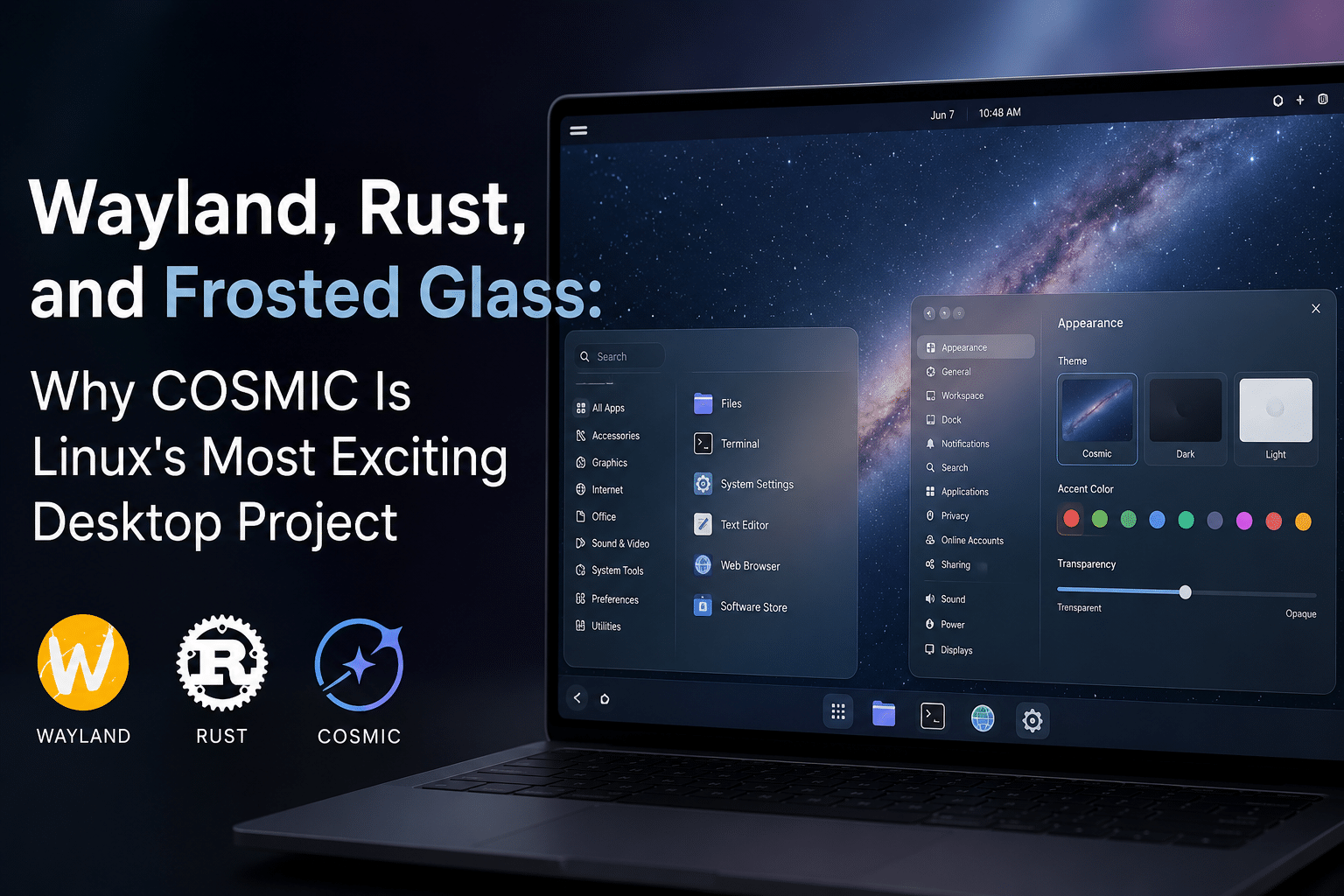
Wayland, Rust, and Frosted Glass: Why COSMIC Is Linux’s Most Exciting Desktop Project
Linux desktop innovation has entered a fascinating new phase.
For years, discussions around Linux desktop environments centered on incremental improvements. GNOME refined its workflow. KDE Plasma pushed customization boundaries. XFCE focused on stability and efficiency. Cinnamon delivered familiarity for users transitioning from Windows.
Then came COSMIC.
Originally introduced as a customized GNOME experience by System76, COSMIC has evolved into something far more ambitious: a completely independent desktop environment built from the ground up using Rust and designed specifically for the Wayland era.
The latest addition—frosted glass visual effects—may appear to be a simple aesthetic enhancement. In reality, it reflects a deeper shift in how Linux desktop environments are being designed. COSMIC is not merely adding visual polish; it is rethinking desktop computing around modern graphics pipelines, memory-safe programming, and contemporary user experience principles.
For developers, enterprises, cloud workstation providers, and Linux enthusiasts, COSMIC represents one of the most significant desktop projects in recent years.
Why Linux Needed a New Desktop Vision
The Linux desktop ecosystem has always been rich in choice.
Users can select from:
- GNOME
- KDE Plasma
- XFCE
- Cinnamon
- MATE
- LXQt
- Budgie
- Deepin
While this diversity is a strength, it has also fragmented innovation.
Many desktop environments carry architectural decisions that date back decades. They continue to maintain compatibility with technologies originally designed for hardware and workflows that no longer exist.
Modern computing environments demand:
- High-refresh-rate displays
- Multi-monitor configurations
- HDR support
- GPU acceleration
- Fractional scaling
- Touch interfaces
- Cloud workspaces
- AI-assisted workflows
Meeting these requirements often means working around legacy limitations.
System76 recognized this challenge and made a bold decision: build a modern Linux desktop from scratch.
The Rust Foundation
One of COSMIC’s most distinctive characteristics is its extensive use of Rust.
Rust has become one of the fastest-growing programming languages in the software industry.
Major technology companies increasingly adopt Rust because it offers:
- Memory safety
- Thread safety
- High performance
- Predictable resource management
- Reduced security vulnerabilities
Traditional desktop environments rely heavily on languages such as C and C++.
Although these languages provide excellent performance, they introduce significant risks:
- Memory leaks
- Buffer overflows
- Use-after-free vulnerabilities
- Race conditions
Rust eliminates entire classes of these problems at compile time.
This matters because desktop environments have become increasingly complex.
Today’s desktop must manage:
- Windows
- Graphics compositing
- Input handling
- Network communication
- GPU acceleration
- Security boundaries
- Application sandboxing
Each additional layer introduces potential vulnerabilities.
By choosing Rust, COSMIC gains a significant architectural advantage.
Developers can focus more on innovation and less on memory management issues.
Why Wayland Changes Everything
If Rust provides the foundation, Wayland provides the platform.
For decades, Linux graphical environments relied on X11.
The X Window System has served Linux remarkably well, but it was designed during an era of:
- CRT monitors
- Single-display setups
- Limited graphics acceleration
- Local computing environments
Modern computing requirements expose the limitations of X11.
Common challenges include:
Screen Tearing
Rendering inconsistencies can appear during motion.
Fractional Scaling Issues
High-DPI displays often require awkward workarounds.
Security Concerns
Applications can potentially observe inputs intended for other applications.
Multi-Monitor Complexity
Managing modern display configurations becomes increasingly difficult.
Wayland addresses these issues through a fundamentally different architecture.
Benefits include:
- Better security
- Lower latency
- Improved graphics performance
- Smoother animations
- Better support for modern displays
- Cleaner compositing pipelines
Because COSMIC was designed specifically around Wayland, it avoids many of the compromises older desktop environments face.
Frosted Glass Effects: More Than Eye Candy
Recent developments introduced frosted glass effects into COSMIC.
At first glance, this might seem like a purely cosmetic enhancement inspired by modern operating systems.
However, visual design significantly influences productivity.
Modern interface research consistently shows that users navigate information more effectively when interfaces establish clear visual hierarchy.
Frosted glass effects help achieve this through:
Layer Separation
Users can distinguish foreground and background content more naturally.
Reduced Visual Noise
Blurred backgrounds prevent distractions while maintaining contextual awareness.
Enhanced Focus
Active elements become easier to identify.
Improved Spatial Understanding
Transparency provides subtle cues regarding interface organization.
For users spending eight or more hours per day in front of a workstation, these details matter.
Productivity is often determined by hundreds of small interactions rather than a single major feature.
Performance Matters
Visual effects frequently raise concerns regarding performance.
Historically, desktop effects often introduced:
- Increased memory consumption
- GPU overhead
- Input lag
- Animation stutters
COSMIC takes a different approach.
Because the desktop environment is being developed around modern rendering technologies from the beginning, visual effects can integrate directly into the rendering pipeline.
Advantages include:
- Better GPU utilization
- Reduced rendering complexity
- Lower latency
- Improved frame consistency
As graphics hardware becomes increasingly powerful, users no longer need to choose between aesthetics and performance.
COSMIC demonstrates that both can coexist.
A Desktop Designed for Developers
Developers represent one of COSMIC’s most important audiences.
System76 has deep roots in developer-focused hardware and software.
As a result, COSMIC includes design choices that align naturally with engineering workflows.
These include:
Efficient Workspace Management
Developers frequently manage dozens of windows simultaneously.
Keyboard-Centric Navigation
Power users can navigate rapidly without leaving the keyboard.
Multi-Monitor Optimization
Development workflows often involve several displays.
Flexible Customization
Engineers can adapt environments to match personal preferences.
Modern Application Support
Wayland-native applications benefit from smoother integration.
This focus makes COSMIC particularly attractive for software development teams.
The Enterprise Perspective
Enterprises increasingly evaluate Linux desktop deployments.
Several trends drive this shift:
- Rising software licensing costs
- Security concerns
- Remote work expansion
- Developer workforce growth
- Cloud-native operations
A modern desktop environment strengthens Linux’s position in enterprise environments.
Decision-makers increasingly recognize that user experience influences adoption rates.
Employees expect:
- Responsive interfaces
- Professional design
- Consistent behavior
- Modern workflows
COSMIC addresses these expectations while preserving Linux’s traditional advantages.
The Cloud Workstation Revolution
The desktop itself is only part of the story.
Where desktops run is becoming equally important.
Organizations increasingly deploy:
- Virtual workstations
- Remote desktops
- Cloud development environments
- Hosted Linux workspaces
This trend continues accelerating because it offers:
Hardware Flexibility
Users can access powerful environments from lightweight devices.
Centralized Management
IT teams gain greater control over infrastructure.
Security Improvements
Data remains within managed environments.
Global Accessibility
Teams collaborate from anywhere.
Modern desktop environments such as COSMIC become even more valuable in cloud scenarios because visual quality directly impacts user satisfaction.
Why HOMERDP Fits Perfectly Into This Evolution
As Linux desktops become more sophisticated, infrastructure providers must evolve alongside them.
HOMERDP provides an ideal platform for organizations seeking to deploy modern Linux environments without investing heavily in physical hardware.
The combination of COSMIC and HOMERDP offers several advantages.
High-Performance Linux Desktops
Users gain access to powerful Linux workstations from virtually any location.
Remote Development Environments
Developers can provision cloud-based workspaces quickly and efficiently.
Scalable Resources
Projects can scale CPU, RAM, and storage as requirements evolve.
Consistent User Experience
Teams access identical desktop environments regardless of device.
Reduced Operational Complexity
Organizations can focus on development rather than infrastructure maintenance.
As COSMIC continues adding advanced graphical features, hosted Linux workspaces become increasingly attractive for enterprises and distributed teams.
Security Benefits Beyond Appearance
Security remains a major consideration for desktop environments.
COSMIC benefits from multiple security-focused decisions:
Rust Memory Safety
Many common vulnerabilities disappear before code executes.
Wayland Security Model
Applications receive stronger isolation.
Modern Development Practices
The project embraces contemporary software engineering standards.
Reduced Legacy Burden
Fewer historical compromises mean fewer inherited risks.
For organizations managing sensitive workloads, these benefits are significant.
The Future of Linux User Experience
Several industry trends suggest that COSMIC’s timing is ideal.
AI Development Growth
Linux remains the preferred platform for AI workloads.
Remote Engineering Teams
Distributed workforces require flexible desktop environments.
ARM Expansion
Energy-efficient hardware continues gaining momentum.
Cloud Infrastructure Growth
Workstations increasingly move into data centers.
Open Source Adoption
Organizations continue embracing open-source technologies.
COSMIC aligns naturally with all of these developments.
Competing Against Windows and macOS
Linux desktops historically competed on freedom, customization, and cost.
Today, the competition has expanded.
Users now evaluate:
- Design quality
- Responsiveness
- Visual polish
- Workflow efficiency
- Hardware integration
COSMIC demonstrates that Linux can compete on all fronts.
The desktop is no longer merely functional.
It is becoming genuinely beautiful.
The addition of frosted glass effects symbolizes this transition.
Linux developers increasingly recognize that aesthetics and productivity are not opposing goals.
They are complementary objectives.
Why COSMIC Could Define the Next Decade
Many desktop projects attempt incremental improvement.
COSMIC takes a more ambitious approach.
Instead of layering new features onto decades-old foundations, it embraces modern technologies from the beginning.
Its combination of:
- Rust
- Wayland
- Contemporary UI design
- Advanced graphics
- Strong security principles
- Developer-focused workflows
creates a platform uniquely positioned for future growth.
The project arrives at a moment when Linux desktop adoption is expanding beyond enthusiasts into enterprises, cloud environments, AI development, and remote workstations.
That convergence makes COSMIC one of the most strategically important desktop initiatives in the Linux ecosystem today.
Final Thoughts
The introduction of frosted glass effects may seem like a minor visual update, but it represents something much larger.
It highlights COSMIC’s commitment to building a desktop environment designed for the next generation of Linux computing.
Rust delivers safety.
Wayland delivers modern graphics architecture.
Frosted glass effects deliver refined user experience.
Together, they form a compelling vision for the future of desktop Linux.
For developers, enterprises, startups, and technology enthusiasts, COSMIC is more than another desktop environment. It is a demonstration of what Linux can become when modern engineering principles meet thoughtful design.
And when paired with scalable cloud infrastructure from HOMERDP, the result is a modern Linux workspace capable of supporting everything from software development and DevOps operations to AI experimentation and enterprise productivity.
The Linux desktop future has arrived—and COSMIC is helping lead the way.
EXPLORE MORE; Rocky Linux Meets Post-Quantum Security
READ OUR BLOGS